James and the Giant Corn Genetics: Studying the Source Code of Nature

March 23, 2010

Paintings of the last supper reflect growing abundance of food.

Filed under: Link Posts — James @ 8:35 am

“The last thousand years have witnessed dramatic increases in the production, availability, safety, abundance and affordability of food…. We think that as art imitates life, these changes have been reflected in paintings of history’s most famous dinner.” – Brian Wansink (Cornell University)

Read more at Discoblog. Note that these results are normalized to head size, so I suppose the alternative explanation is painters have started giving their subjects smaller heads over the past 1000 years.

March 22, 2010

Regarding Scientists…

Filed under: Uncategorized — James @ 6:22 pm

Finally, let me speak up for scientists. In my experience, the vast majority of scientists are honest, sometimes slightly nerdish people who are grateful to be able to work on something about which they have a passionate interest. Scientists can be arrogant: but overall they do not deceive themselves, or the public.

From an article written by Philip Strange. I’m not sure about slightly nerdy, but there is a lot of variation even among people studying science, and I’m probably at the nerdy end of the spectrum.

Getting back in the saddle

Filed under: Recreational Travel — James @ 11:41 am

I got back from the maize meeting in Italy last night to find my DSL connection at home was dead again. I’m now at work and think I’m pretty much caught up with the backlog of internet related stuff that accumulated during my absence. So if you e-mailed me, tweeted at me, or commented on a post sometime in the last week, please accept my apologies for not getting back to you before now.

And if you still haven’t heard back from me, please try getting in touch again.

Random thoughts from my travels:

  • Carrying a 40 inch long poster case 1/3 of the way around the earth and back again certainly gives me a new appreciation for the training old fashioned riflemen (whose rifles were much longer than my poster) must have had.
  • Travelling with three other Americans makes other countries seem a lot less foreign. We talked among ourselves in english, and while the language barrier meant we never asked for directions, as a group of four men we wouldn’t have been living up to our stereotype by asking for directions even if we’d been able to. Walk even 100 feet away and the awareness of being in a strange land (and not speaking a word of the native language), suddenly sinks in.
  • German airports list departing flights by time of departure, not the name of the destination city. (It look an embarrassingly long moment to realize flights weren’t simply listed at random.)

March 20, 2010

Gene Annotation Won’t Kill You

Filed under: Uncategorized — James @ 3:43 pm

I just got out of a meeting about how we’re going to improve the annotations of the maize genome. It’s got me riled up.

But first, what is gene annotation (in twenty words or less): (more…)

Transcriptome Sequencing!

Filed under: Uncategorized — James @ 1:16 am

One of the themes, looking over the abstracts and talks for this year’s maize meeting before I leave is that a year from now we can expect to have much more detailed information about where genes are expressed in corn, and at what levels. One of the great dividends of the dropping cost and increasing speed of short read sequencing.

At this meeting alone we’ll be hearing about the incredibly detailed leaf transcriptome[1] (which seperates out expression of four developmental zones of the leaf, plus uses laser capture to look at the expression of genes the bundle sheath and mesophyll cells within the maize leaf seperately). And at least two posters on the subject also caught my eye (although there may be a lot more that involve profiling expression using high throughput sequencing). Two groups based at Oregon State and Stanford are in the process of sequencing the transcriptomes of the male and female gametophytes* of maize[2], and a group based primarily at Cold Spring Harbor is in the proccess of sequencing the transcriptome of developing ears (the kind covered in corn kernels, not the kind you hear out of)[3]. Both of these transcriptomes actually represents a number of seperate data sets from different tissue types and/or developmental stages.

All these datasets makes me wish the Fort Lauderdale Accords** applied to expression data in addition to genome sequences themselves, but since it doesn’t, I’ll happily oooh and awww over other people’s cool data.

A special thanks to Andrea Eveland’s abstract for introducing me to units that can actually quantify the wa expression is measured in these studies RPKM (Reads Per Kilobase of exon per Million reads).

*Plants practice alteration of generations, switching between diploid (two copies of the genome, one from each parent) and haploid (only a single copies of their genome) multicellular forms of life. In flowering plants, the kind we spend most of our time with, the haploid generation is almost vestigial, but it still exists. Plant pollen contains an entire male haploid plant (the male gametophyte), which has been reduced to a mere three cells (two which are sperm cells). The female gametophytes of flowering plants are only a little larger, at seven cells. In other plants, the gametophyte can exist as a free living life form visible to the naked eye.

**The agreement that allows genome sequence data to be released to the whole community before the people who sequenced that genome have published their paper.

[1] Pinghua Li et al. “Characterization of the maize leaf transcriptome through ultra high-throughput sequencing” Talk #14 2010 Maize Meeting (Presented by Thomas Brutnell)

[2] Rex A. Cole et al. “Analysis of the Maize Gametophytic Transcriptomes” Poster #27 2010 Maize Meeting (Presented by Matt Evans)

[3] Andrea L. Eveland et al. “Transcriptome sequencing and expression profiling during maize inflorescence development.” Poster #113 2010 Maize Meeting

March 19, 2010

Helitron Capture Creating New Genes?

Filed under: biology,Genetics — James @ 1:15 am

One of the things that has made annotating genes in the maize genome so difficult (there are currently two sets of gene models one with only 32,000 genes, which is low estimate, and the other with 100,000 is far too many) is the presence of large numbers of gene fragments that have been captured and duplicated by a class of transposon called helitrons (yes I know that sounds like a character from Transformers).

The helitron captured fragments are copied from real genes (often multiple pieces are captured from different genes) which is why many gene annotation programs (trained to recongize the difference between genes and non-coding DNA) will identify the fragments being genes themselves.

What if some of those fragments actually are genes? By combining pieces from completely different genes, helitrons could be a whole new source of crazy new genes that natural selection could act upon.

That is the question the authors of this poster are trying to get at, by identifying more helitron fragments and checking to see if those fragments were actually expressed in the genome.

Allison Barbaglia et al. “Accessing the transcriptional activity of Helitron-captured genes of maize” Poster #243 2010 Maize Meeting

March 18, 2010

Missing Genes on a Massive Scale

Filed under: biology,Genetics,genomics — James @ 1:15 am

Edit: stripped out all the numbers as they clearly applied to an earlier version of the data and I don’t know if the new ones are intended for public release yet.

Last november when the maize genome was published, one of the companion papers looked at genes where a different number of copies were found in different breds of maize (this is called Copy Number Variation) and genes found in B73 (the variety of maize that was sequenced) but completely missing from the genomes of other varietes. There’s a great post on that paper written up by Mary at OpenHelix.

A few months later, it sounds like this dataset has grown substantially. Over XXXX B73 genes (that’s X% of the filtered B73 gene set!) that appear to be lost (or have sequences so different they no longer register) in at least some varities of maize. And because the new dataset incorporates data from XX different maize breds and XX different teosinte* lines they’re able to identify some of the losses as older because they’re found in multiple comparisons, while some appear to be lost in only a single breed, and might represent more recent losses.

Sit back and think about that for a second. At least X% of the genes in corn sometimes go missing. This could have implications for everything from inbreeding depressions and hybrid vigor, to the kind of basic research I’m actually working on myself.

As you can imagine I’d love to get my hands on this dataset myself, but the next best thing will be to take furious notes when Nathan Springer talks about the project on Friday morning**, and being sure to swing by Steven Eichten’s poster soak in the awesomeness.

Ruth A. Swanson-Wagner et al. “Combined Analysis of genomic structural variation and gene expression variation between maize and teosinte populations” Talk #1 2010 Maize Meeting (Presented by Nathan Spinger)

Steven R. Eichten et al. “Extenisve Copy Number Variation Among Maize Lines” Poster #139 2010 Maize Meeting

*Teosinte is the wild species from which maize/corn was domesticated.

**And he’s talking at 8:30 AM on a day when I still plan on being heavily jet lagged.

March 17, 2010

Abnormal Chromosome 10

Filed under: biology,Genetics — James @ 1:14 am

There is a piece of DNA that is sometimes found on the end of the tenth maize chromosome. In plants that possess this extra chromosome segment, chromosome knobs* (including one that’s a part of the extra segment included in abnormal chromosome 10) start to act like centromeres**. But this story graduates from odd to downright weird when I tell you that possessing this extra centromere-like activity gives a chromosome an unfair advantage in being passed on to the next generation.

Plants, like animals, possess two complete genome copies, one from each parent. They’ll only pass on one copy (mixtures of pieces from each parent) to their offspring. Any given sequence has a 50% chance of being passed on which seems fair given the plant is passing on 50% of its total genetic material. But abnormal chromosome ten cheats (using those extra centromere-like sequences I mentioned earlier). It has up to an 83% chance of being passed on.

Since the breed of corn (B73) the maize genome was based on has the normal version of chromosome 10, we know very little about the extra DNA found in abnormal chromosome 10. The authors of this poster are going to correct that oversight, by sequencing the region, figuring out how (and how long ago) abnormal chromosome 10 came into being, and hopefully identifying the genes within the region that make chromosome-knobs act like centromeres.

*Knobs are dense segments of DNA that scientists have been able to spot visually within chromosomes since before we knew for sure that chromosomes carried genetic information.

**Centromeres are the part of the chromosomes that bind together during cell division (the center of the X in the traditional drawing of a chromosome). They’re also the place where the molecular machinery that pulls chromosomes apart at the end of the process of cell division.

Lisa Kanizay and Kelly R. Dawe “Uncovering the sequence and structure of maize abnormal chromosome 10” Poster #165 2010 Maize Meeting.

March 16, 2010

Leaving for the maize meeting

Filed under: Uncategorized — James @ 1:46 am

The maize meeting is a once a year chance for people nearly as into studying corn as I am to gather in one place, talk science, drink beer, and talk science.

I’ve got a few pre-scheduled updates (fewer than I was planning) based on interesting posters and talks I want to check out at the meeting, but aside from that you probably won’t be hearing much from me for the rest of the week.

Hopefully I’ll see at least a few of you there!

March 15, 2010

The long genome drought

Filed under: genomics,research stories — James @ 4:03 pm

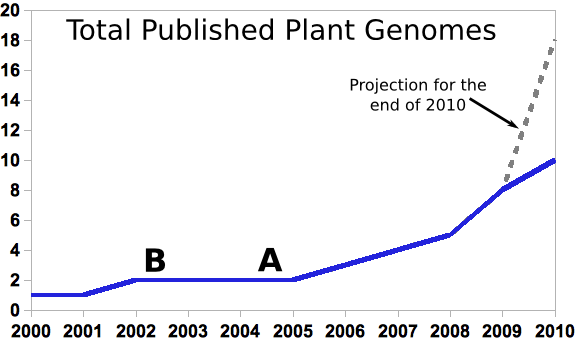
Grad students graduating with PhDs right now probably entered grad school at point A, or earlier. People at the end of their first post-doc (and potentially in a position to apply for faculty positions and start training new graduate students themselves) would have entered grad school at point B or earlier.

Today there are a mere 10 published plant genomes out of the more than quarter million named plant species in the world. But even ten genomes is a huge amount of data to deal with for a plant genomics community that largely came of age during the long genome drought of 2002-2006. What is the genome drought? The rice genome was published in April 2002. It was only the second plant genome to be sequenced, and the last plant genome to be published until the poplar genome came out in September of 2006, a gap of more than four years. Two genomes, especially of species as distantly related as arabidopsis and rice doesn’t make for a lot of compelling comparative genomics (Although there was certainly some really cool stuff being discovered in this time period.)

Does that matter? Probably not, but it’s important to remember that the people earning their PhDs today probably entered grad school (and chose a lab and field of study) during that two-plant-genome era (see point A) and less opportunity for exciting research mean less grant money and less ability to attract grad students. The youngest people applying for faculty positions today (assuming they only did one, quite successful, post-doc), also entered grad school in the two genome era (see point B), if not the previous single genome era.

I’m talking about this mostly to make the point that I think comparative genomics as a field of study is getting a lot more exciting as more genomes become avaliable, which is likely to attract more graduate students in that key first year when they join a lab and begin to specialize. Which means as we move farther away from the time of the long genome drought, we will hopefully* start to see a lot more well trained people doing plant genomics.

Which is a good thing because the other point this graph should make (not that I think many people need to be reminded of it), is that the pace of sequencing plant genomes is accelerating, and SOMEONE needs to analyze the huge quantities of data that are already starting to flow through the plant biology community.

This should be the last plant genome themed post for a while, but please continue to let me know if you know/hear about more plant genome projects. jcs98 (@) jamesandthegiantcorn.com

*If the hypothetical end to the also-hypothetical-and-possibly-the-result of-wishful-thinking-on-my-part shortage of plant comparative genomicists could hold off long enough for me to be really in demand when/if I finish grad school, that would be great. 😉

« Newer PostsOlder Posts »

Powered by WordPress