James and the Giant Corn Genetics: Studying the Source Code of Nature

September 11, 2009

The Family of Wheat

Filed under: Plants — James @ 3:03 pm
The latter is a result of wheat’s amazing family tree. The wheat that produced the bread for that sandwich you had for lunch can trace its ancestry back to two grasses growing in the middle east thousands of years ago and a third growing somewhere along the shores of the mediterranean. The wheat first domesticated in the middle east was already a combination of two native grasses, containing the complete genomes of both. While humans have 23 chromosomes and two copies of each, this wheat had only seven chromosomes and four copies of each (two from each of the grasses that had given rise to it).  This wheat was already a good crop, its seed was spread from tribe to tribe and village to village. And it was somewhere along that journey that wheat encountered the third grass, and one of the offspring generated when pollen from that wild grass landed on wheat growing in some farmers field, instead of being a sterile hybrid as usually happens when dissimilar species mate, was able to reproduce and had a better gluten, the combination of proteins that gives wheat the elasticity to hold together as dough, which lead to better bread and soon bread wheats swept across the continents in many places replacing the older wheats that had been grown before.*****
The problem from a genomicist is that each bread wheat cell how contains 42 chromosomes. Remember each of the grass species that gave rise to wheats had seven chromosomes, each with two copies for 14 chromosomes per cell. Seven chromosomes each from of its parents (for 21) and two copies of each brings us to 42. Which is still four less than human cells, so where’s the problem? The different from the human genome is that each of set of seven chromosomes makes up a closely related yet distinct genome. So as bits of DNA are sequenced it is hard to know whether the pieces their overlap are really from the same part of the genome, or instead related sequences from one of wheats other parents (and located on an entirely separate chromosome). Imagine a giant heap of puzzle pieces from three puzzles each made with identically shaped pieces and make very similar pictures although you don’t know what any of the pictures will look like. That’s what trying to sequence the wheat genome will be like

As promised the second part of my giant entry on wheat. Yesterday I talked about yield and breeding techniques. Today I’m going to talk about where wheat can from, and why, if you ever happen to meet a wheat genomicist, you know you’re in the presence of someone incredibly hard core.

The wheat that produced the bread for that sandwich you had for lunch can trace its ancestry back to two grasses growing in the middle east thousands of years ago and a third growing somewhere along the shores of the mediterranean. The wheat first domesticated in the middle east was already the offspring of two native grasses, containing the complete genomes of both. While humans have 23 chromosomes and two copies of each, this wheat had only seven chromosomes and four copies of each (two from each of the grasses that had given rise to it).  This wheat was already a good crop, its seed was spread from tribe to tribe and village to village. And it was somewhere along that journey that wheat encountered the third grass, and one of the offspring generated when pollen from that wild grass landed on wheat growing in some farmers field, instead of being a sterile hybrid as usually happens when dissimilar species mate, was able to reproduce and had a better gluten, the combination of proteins that gives wheat the elasticity to hold together as dough, which lead to better bread and soon bread wheats swept across the continents in many places replacing the older wheats that had been grown before.*

The problem from a genomicist is that each bread wheat cell how contains 42 chromosomes. Remember each of the grass species that gave rise to wheats had seven chromosomes, each with two copies for 14 chromosomes per cell. Seven chromosomes each from of its parents (for 21) and two copies of each brings us to 42. Which is still four less than human cells, so where’s the problem? The different from the human genome is that each of set of seven chromosomes makes up a closely related yet distinct genome. So as bits of DNA are sequenced it is hard to know whether the pieces their overlap are really from the same part of the genome, or instead related sequences from one of wheats other parents (and located on an entirely separate chromosome). Imagine a giant heap of puzzle pieces from three puzzles each made with identically shaped pieces and make very similar pictures although you don’t know what any of the pictures will look like. That’s what trying to sequence the wheat genome will be like.

*Durum wheat, which is still grown for pasta, is still a tetraploid wheat without the additional chromosomes from the third parent of bread wheats. I guess the gluten of bread wheat doesn’t hold up as well in pasta, the same trait that makes it excellent for breads.

September 10, 2009

Why Wheat Is Losing Out in the Era of Modern Crop Breeding

Filed under: Uncategorized — James @ 4:04 pm
Wheat occupies a special place in the mind of anyone who grew up surrounded by western cuisine. Wheat is the source of bread, and bread is intrinsic to our concept of food. In the same way rice, in all it’s many gorgeous and delicious incarnations, is central the the idea of food in south indian and east asian cultures. Or corn tortillas in mexico. Human civilization was built upon of the unrivaled productivity of these three grains. And when modern medicine increased the rate of population growth, it was primarily these three grains (and wheat first of all) that we turned to in the green revolution to fill the gap between what current farming methods could produce and what was needed to save our fellow human beings from starvation.
In the US the technologies that made the green revolution possible, were available earlier. Around the end of world war two, most of the infrastructure that had been built up to fight the war could be turned over to peaceful uses, one of which was man-made nitrogen fertilizer. Nitrogen, for centuries on of the major limits of yield was now available in quantities that couldn’t have even been dreamt about at the turn of the century. At the same time, hybrid corn seed* began to be available in substantial quantities from, among other sources, Pioneer Hi-bred.
Wheat received the benefits of increased fertilizer, but the architecture of wheat flowers, with male and female parts combined in a single flower makes creating hybrids difficult** and as far as I know even today not cost effective. So wheat yields increased but through no fault of its own as a food crop, not to the same extent as corn. Rice was in a similar predicament, reaping the benefits of increased fertilizer and greater attention to breeding, but not the huge benefits of hybrid vigor.***
And how it looks like wheat may once again miss out on new advances in the form of genetic engineering. GM maize was one of the first crops brought to market and as been an agricultural (if not public relations) success. I’m not sure if GM rice is on the market or not, but I do know many lines are in development from golden rice that addresses the vitamin A deficiencies found in people dependent on rice for almost all their calories****, to rice that can be irrigated with brackish (salty) water where fresh water is scarce, to flood resistant rice that can thrive what fresh water is TOO abundant.
I know of no one planning to release GM wheat and even wheat genomics is far behind the rice and maize communities.
The latter is a result of wheats amazing family tree. The wheat that produced the breed for that sandwich you had for lunch, can trace it’s ancestry back to two grasses growing in the mediterranean thousands of years ago and a third growing somewhere along the shores of the mediterranean. The wheat first domesticated in the middle east was already a combination of two native grasses, containing the complete genomes of both. While humans has 23 chromosomes and two copies of each, this wheat had only seven chromosomes and four copies of each (two from each of the grasses that had given rise to it).  This wheat was already a good crop it’s seed was spread from tribe to tribe and village to village. And it was somewhere along that journey that wheat encountered the third grass, and one of the offspring generated when pollen from that wild grass landed on wheat growing in some farmers field, instead of being a sterile hybrid as usually happens when dissimilar species mate, was able to reproduce and had a better gluten, the combination of proteins that gives wheat the elasticity to hold together as dough, which lead to better bread and soon bread wheats swept across the continents in many places replacing the older wheats that had been grown before.*****
The problem from a genomicist is that each bread wheat cell how contains 42 chromosomes. Remember each of the grass species that gave rise to wheats had seven chromosomes, each with two copies for 14 chromosomes per cell. Seven chromosomes each from of its parents (for 21) and two copies of each brings us to 42. Which is still four less than human cells, so where’s the problem? The different from the human genome is that each of set of seven chromosomes makes up a closely related yet distinct genome. So as bits of DNA are sequenced it is hard to know whether the pieces their overlap are really from the same part of the genome, or instead related sequences from one of wheats other parents (and located on an entirely separate chromosome). Imagine a giant heap of puzzle pieces from three puzzles each made with identically shaped pieces and make very similar pictures although you don’t know what any of the pictures will look like. That’s what trying to sequence the wheat genome would be like.
But a complicated (and awesome) genome isn’t the only thing holding back wheat research. After all GM maize has been on the market for more than a decade and the genome hasn’t been available until recently and still hasn’t been officially published. The other major barrier is a side effect of wheat’s success and cultural status.
Corn is essential to feeding Americans (and Europeans) every day, but we don’t see it as most of it is camouflaged in cornfed beef and pork, and hidden in the ingredient lists of processed foods. Rice feeds people directly, but far to many of the people who depend on it are more worried about whether they’ll have enough to feed themselves and their children than the techniques used the harvests don’t fail, and yields increase. Wheat on the other hand mostly eaten in recognizable forms like bread and pasta and much of it is consumed by people who are a generation or more removed from the sort of food insecurity that still plagues hundreds of millions around the globe. These are people, like myself, who can say, “this new technology feels wrong” because the difference for them is a few more quarters for a loaf of bread, not whether they have to spend the money that could have gone to sending one of their children to school on food, or whether they can feed all their children at all.
And that’s the reason no one is investing in biotech wheat. Saving a little money on production, or even reducing the use of the most toxic pesticides and/or reducing topsoil loss by being able to switch to no-till farming, hasn’t been worth the risk to farmers that their harvest will become worthless if consumers refuse to purchase GM bread. Without the demand from farmers, seed companies won’t invest the resources, and even with the demand, they’d weigh the profit of selling the seed against the risk of stirring up more opposition among consumers. Monsanto really doesn’t need any more negative publicity.
*For a summary of what hybrid seed is and its benefits check here
**To make a hybrid you have to mate two dissimilar parents. To do that with plants, you often have to prevent the plants from mating with themselves. This is a simple process for corn since the female flowers (the ears) are physically separate from the male flowers (the tassel). All thats required to to bus a bunch of high school kids willing to work for minimum wage out to a cornfield, and have them walk down the rows pulling the tops off of the “female” parent. After the females are pollinated by the “male” parent, the male plants (which still have both male and female flowers) are chopped down to allow more light to reach the female plants and at harvest, and the seeds are hybrid since their female parent must be the plant they’re growing on, and their male parent can only be corn plants that kept their tops (and tassels). Now imagine how much work it would be to go through a field of, say tomatoes, with a magnifying glass and a pair of tweezers removing only the male parts of each flower and leaving it otherwise intact.
***I’ve heard there’s actually been some success recently with producing hybrid rice using CMS. Cytoplasmic male sterility is a mutation carried in one of the organelle genomes (the small genomes of the chloroplast and mitocondria) which keeps plants from producing pollen (plant sperm). Because the cytoplasm of an embryo (whether cucumber or human) comes from only the mother, CMS traits are passed from a mother to all offspring. So you have a female inbred that’s male sterile and when you grow it with a normal you know all the seeds on the female plants must be hybrid since the only pollen avaliable to fertilize them was from the other inbred line. It’s even more complicated than my confused explanantion makes it sound, but it’s a lot better than hiring people to go out their with magnifying glasses and tweezers.
****We don’t have to worry about that particular problem with corn since the vast majority of corn grown in the US carries a gene which produced carrotinoids (vitamin A precoursors) in the kernals. Before plant breeders started selecting for that trait, most corn we grew was white. Of course if you go even further back, corn looked all sorts of different ways.
*****Durum wheat which is still used for making pasta and for some traditional breads in the middleeast survived competition from bread wheats and is one of the few remaining agriculturally significant tetraploid wheats.

Wheat occupies a special place in the mind of anyone who grew up surrounded by western cuisine. Wheat is the source of bread, and bread is intrinsic to our concept of food. In the same way rice, in all it’s many gorgeous and delicious incarnations, is central the the idea of food in south indian and east asian cultures. Or corn tortillas in mexico. Human civilization was built upon of the unrivaled productivity of these three grains. And when modern medicine increased the rate of population growth, it was primarily these three grains (and wheat first of all) that we turned to in the green revolution to fill the gap between what current farming methods could produce and what was needed to save our fellow human beings from starvation. Yet wheat is falling behind the other members of the big three grains.

(more…)
September 8, 2009

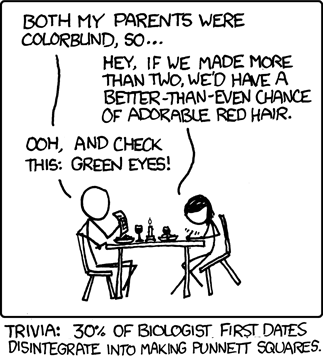
Biologist First Dates

Filed under: Uncategorized — James @ 10:05 pm

I’ve actually had this come up on a first date once. Though I didn’t actually draw the squares. (Real biologists can do three trait Punnett Squares in their heads.)

September 1, 2009

Posting in twos

Filed under: Uncategorized — James @ 6:31 pm

Seems to be becoming a habit:

Olivia Judson, one of the best people are making biology exciting for the general public (I can’t recommend her book enough) has a new article up on nytimes on genomes and asking the question, what genome  would you choose to sequence if you could. Probably won’t tell you much you didn’t already know, but it’s a warm fuzzy feeling none the less.

From the title “The Fantasy Genome Project” I was all ready to advocate for the dragon genome! After all it’s a hexapod vertebrate , which is awesome even without considering that dragons are cool!

Assorted Updates

Filed under: Campus Life — James @ 5:27 pm

So it’s been a couple of weeks since I’ve updated. In that time I’ve:

Been back to Iowa for a few days where I feasted on giant hamburgers and saw a friend’s new house and kitten and another friend’s duplex. Enough to make a guy feel like he’s falling behind.

Bought and assembled a bicycle! The hardest part was setting the brakes properly. Since then I’ve been building up from a fifteen foot ride, to about 1.7 miles up a very slight incline and back again. Keep in mind I hadn’t ridden a bike since I got my drivers license back in 2001. That’s eight years, a major fraction of my life.

Had class start out here. It doesn’t really impact me much except there are a lot more people on campus.

Relatedly, the new first year students arrived. A smaller group than my year, they all seem frighteningly competent. At least three, possibly four, of the five new plant grads already have experience programming. They went to more prestigious schools. They’re way better about picking the best professors to rotate with than my class was when we just started out. I wish them all the best of luck.

Inherited an awesome new workstation in lab. Quad-core-dual-processor for a total of eight cores, dual monitors, running Ubuntu (of course), and I finally has a reason to use digital blasphemy’s multi-screen resolutions. Means I’m having to learn more about multithreading my scripts to take advantage of the power have available.

Still working on my post of basic genetics.

August 19, 2009

In Defense of Hybrids

Filed under: Uncategorized — James @ 12:17 am

Hybrids are good. Excellent even. If anyone tells you otherwise, you send them to me.

Alright I’ll take a couple of steps back. Hybrids are always hard to explain, I’ve tied myself in nots a couple of times tying to, but maybe this time is the charm. At it’s most fundamental levels, a hybrid is nothing more than the offspring of two dissimilar parents. When Gregor Mendel discovered the fundamental principle of genetics* he wasn’t setting out to study genetics, or the basic principles of life, but instead the traits of the offspring of dissimilar pea plants. And he published his findings under the title Experiments on Plant Hybridization.

(more…)

August 11, 2009

Irrigation in India

Filed under: Uncategorized — James @ 6:49 pm

An article yesterday on the science website yesterday discusses the loss of groundwater in northern India. The technical details of how this are measured* are interesting in their own right. But just keep in mind what the final outcome will be if nothing changes from the way it is today.

The region of northern India supports 600 million people many of them in abject poverty and is drawing 54 cubic kilometers of water a year more than is replaced by rainfall. The end result will be human suffering on a scale even greater than currently found around the world.

What can avert this disaster? Three things:

  • Substantial increases in rainfall throughout the year in northern india (beyond human control)
  • Major breakthroughs in desalinization and pumping (desalinization isn’t my field, so I don’t know how likely that one is, however humanity has been studying the field of moving water from one place to another for thousands of years so the odds of a new pumping breakthrough are slim to none)
  • “Drip” irrigation systems. Most irrigation wastes a lot of water. Drip irrigation reduces waste by irrigating each plant individually (no point in getting the ground between plants wet) and doing so slowly so the water soaks entirely into the ground eliminating run off which both saves water and addresses a major source of agricultural pollution and topsoil loss. The downside is drip irrigation is, comparatively, expensive. Which means someone other than the subsistence farmers who need it would have to pay for it.
  • Water-use efficient and salt tolerant crops. Plants that need less water means less irrigation obviously. The benefit of salt tolerance is in the ability to reclaim land where the earth has become too salty for crops to grow well** as a result of irrigating with salty water, and using that same salty water to irrigate, reducing the demand for fresh water.

I’ve listed these option in what I’d guess is increasing return in investment. Throwing 10 billion dollars are changing the earth’s weather patterns won’t make any difference at all. Throwing the same money at desalinization would have real benefits. Investing ten billion in subsidizing drip irrigation systems for subsistence farms would have a huge impact. It probably wouldn’t cost ten billion dollars to get draught and salt tolerant crops into the hands of the farmers who need them. The benefit of stress tolerant crops is that after they’ve been breed, the cost of actually getting them to those who need them is quite low.*** After all plants, like people, are self replicating. Now if someone would just invent a drip-irrigation system that could build additional copies of itself we’d be set.

*Two satellites orbit the globe and can measure water loss based on changes in their orbit which are caused by variation in the strength of earth’s gravitational field.

**Salt is very bad for plants that can’t handle it. Plowing salt into their farmland is an effective if time consuming method to deal with people you don’t like.

***Especially in countries like India where there is a substantial grey market for things like bt cotton seed.

August 10, 2009

Tomato Blight and Common Ground

Filed under: Uncategorized — James @ 2:52 pm

Dan Barber had a column in the new york times on Saturday addressing the major attack of tomato blight in the northeast this summer. Late Blight is a fungal disease that attacks tomatoes and potatoes (edit: Maybe also eggplants? They’re all pretty closely related). When potato harvests fail, people starve (see: Irish Potato famine). With tomato harvests fail… the price of tomatoes goes up and people eat less tomatoes. But I have a serious point to make so please keep reading.

(more…)

June 24, 2009

Fish Farming

Filed under: food — James @ 1:11 am

I’ve never been particularly partial to fish. I suppose I could blame it on growing up in Iowa but I know plenty of people back home who like them, even catch freshwater fish themselves. Regardless, the point I’m trying to make is that I don’t eat a lot of fish. But if I were looking for fish, my preference would be for tilapia. More below. (more…)

June 17, 2009

Phylogeny of Pineapple, an further explanation of awesomeness

Filed under: Plants — James @ 9:34 pm

If you had to guess, how would you rank these species in order of how closely they’re related to to pineapple:

Orange, Papaya, Corn, Avacado, Juniper, Banana

Answer after the jump.

(more…)

« Newer Posts — Older Posts »

Powered by WordPress