James and the Giant Corn Rotating Header Image

Plants

Of course plants are more genetically complex!

Let’s remember back to a time before the human genome project published it’s first draft assembly in 2001. The genome of C. elegans a tiny nematode had already been published with ~20,000 genes. The C. elegans genome is one 1/30 the size of the human genome and the tiny worms are so small that biologists have mapped the developmental fate of every single cell in their bodies (an adult C. elegans has exactly 959 or 1031 cells depending on gender), whereas the human body contains tens of trillions. How many genes would you guess humans have?

Estimates at the time ranged from 40,000 to 150,000 genes. (more…)

Share

Bloggers on the Maize Genome

Update: PolITiGenomics just posted a piece on the corn genome as well.

You know I could keep talking about the maize genome all day (and I may very well do just that), but what are other bloggers saying about the most complicated plant genome ever published, of second most important single species for feeding people around the world? (Clearly I’m not at all excited) (more…)

Share

Maize: The Genome Sequence Itself

The corn genome is ~2.4 gigabases (2.4 billion As, Ts, Cs, and Gs) divided among ten chromosomes. The genome of sorghum, the most closely related species with a sequences genome to maize, is also divided into ten chromosomes, but it’s only less than 800 megabases long, approximately a third the size of maize.

What accounts for the size different? Well since their divergence, maize went through a whole genome duplication, doubling it’s genome to twenty chromosomes (which have since been reduced to ten again, as pieces of chromosomes broke apart and stuck to each other*). Since then a bunch of deletions have also occurred, so only sometimes like 20-30% of the genes from the ancestor of maize and sorghum can still be found in both duplicated regions. Clearly the genome duplication of maize is not responsibly (or at least not solely responsible) for the the enormous size of the maize genome. (more…)

Share

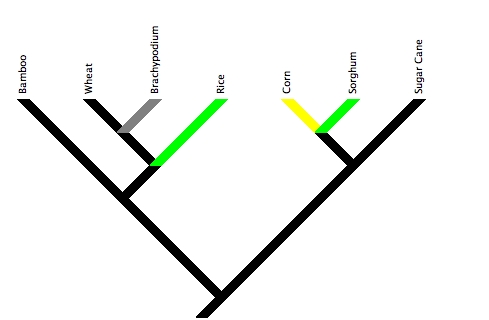
The Family Tree Of Corn

Branches not to scale. Tree designed in Mesquite.

Branches lengths not remotely to scale. Tree designed in Mesquite.

This family tree shows the relationship of a few of the species in the grass family tree that I think people might be most familiar with. Genomes that were published before today are marked in green (there were only two, sorghum and rice), the maize genome which was just published today is marked in yellow, and brachypodium (which you shouldn’t feel at ALL bad if you haven’t heard of) is marked in grey as its genome project is in the final stages (a draft assembly was released to the public last winter) so it’ll probably be the next grass genome to be published. After that I’m less sure, I know there’s a foxtail millet genome project, but I don’t have any idea how far along the process of genome sequencing, assembly and annotation the genome project is.
What’s important to know about the relationship of the sequenced grasses? (more…)
Share

Patrick Schnable on the Maize Genome

Let me know if you have any trouble with the embedded video. The embedding code from ISU doesn’t seem to play well with wordpress.

I’ve got several posts on the maize genome coming out scheduled to go up later today. Living on the west coast (not to mention having a circadian clock that seems convinced I should actually be living on Honolulu time) it’s the only way to get information up in time for morning readers in most of the US.

Anyway, hopefully some of what I’ve written makes sense (I’ll be running a lot of long computational jobs at work so I’ll have plenty of time to answer questions in the comment sections about all the stuff I’ve written that doubtless makes no sense at all). But to start us off this morning, how about a short (<4 minutes) video from Patrick Schnable one of the two lead authors on the maize genome paper. After four years of talking about the corn genome project as well as it’s challenges and benefits, one gets very good at it.*

See the video in it’s original context here. I’m assuming since ISU provides embedding code they’re ok with me showing it here.

*Fair disclosure, there are important reasons I may be biased in my evaluation.

Share

Why should you be excited about the corn genome?

Virginia Walbot has ten reasons in the latest issue of PLOS genetics. PLOS journals are all open access so anyone can read it without a subscription.

The two reasons I think will be the most interesting to non-biologists are #1 and #10:

Corn was domesticated a short 10,000 years ago and domestication is normally a huge genetic bottleneck that results in the loss of much of the gene diversity found in the wild ancestor. (Modern tomatoes are more diverse than heirlooms because breeders are intentionally working to bring some of that diversity back over.) Yet two lines of corn, which certainly shared many common ancestors in the last 10,000 years, contain more genetic differences than humans and chimpanzees which have been evolving separately for 3.5 MILLION years. That’s 10,000 years vs 3,500,000 years!

Number ten drives home how essential corn is to the world today with statistics like American farmers growing so much corn last year than it works out to a metric ton for every man, woman, and child in this country. Or that corn and cornfeed animals feed a billion people around the globe (those aren’t rice numbers, but hopefully it drives home why corn has definitely earned it’s place as one of the big three grains that support civilization around the world).

h/t to the beekeeper (who I haven’t see around the blog in months) for pointing me at this PLOS genetics coverage of the maize genome papers coming out both there and in Science.

Share

Not Genetically Engineered: Grapes

New York Grapes. Concords I believe, though it's been several years so I may be remembering wrong.

New York Grapes. Concords I believe, though it's been several years so I may be remembering wrong.

Scientific Name: Vitis vinifera

Supposed Genetically Engineered Trait: Large size/seedlessness

The Real Story:

Seedless grapes are descended from several different mutations that all result in the developing embryos of grape seeds to abort prematurely*. You can still find the tiny dead remnants of seeds in seedless grapes. Of course being seedless raises a new question: How do plant breeders work with seedless grapes? (more…)

Share

Not Genetically Engineered: Watermelon

I know I'm reusing images, but this is just a really gorgeous watermelon

I know I'm reusing images, but this is just a really gorgeous watermelon

Scientific Name: Citrullus lanatus

Purported Genetically Engineered Trait: Lack of seeds

The Reality:

Seedless watermelons grow on triploid (three copies of every chromosome) watermelon plants. Like the banana, triploid watermelons are seedless because it’s impossible to separate three copies of each chromosome into different different reproductive cells. Unlike bananas, seedless watermelons are grown from seed and must be fertilized by fertile (diploid) watermelons to produce fruit.

Where do farmers get seeds for a seedless plant? (more…)

Share

Genetically Engineered Crops: Papaya

Photo Reeding, Flickr (Click for photo stream)

Photo Reeding, Flickr (Click for photo stream)

Scientific Name: Carica papaya

Genetically Engineered Trait: Resistance to the papaya ringspot virus

Details of Genetic Engineering:

In the 1990s papaya ringspot virus was in the process of wiping out the Hawaiian papaya industry, then the second largest fruit industry in Hawaii. Conventional approaches such as selective breeding for resistant papayas or attempting to grow trees in isolation had failed. The virus is transmitted by small sap-sucking insects such as aphids. Infected papaya trees can be recognized by the discolored rings on their fruit (that the virus gets its name from) yellow leaves, and most importantly from a papaya farmer’s perpsective a 60-100%* loss of fruit production. (more…)

Share

Genetically Engineered Crop: Blue Carnations

Florigene's Moondust carnations, one of several violet and blue varieties they've created with genetic engineering. Photo by Pagemoral and licensed under the creative commons. Click to see the photo in its original context with license information

Florigene's Moondust carnations, one of several violet and blue varieties they've created with genetic engineering. Photo by Pagemoral and licensed under the creative commons. Click to see the photo in its original context with license information

Scientific Name: Dianthus caryophyllus

Genetically Engineered Trait: Anthocyanin biosynthesis (blue and violet plant pigments)

Details of Genetic Engineering:

The market in flowers with genetically engineered colors is (to my knowledge) occupied by a single Australian company called Florigene. They study anthocyanins, the class of plant pigments responsible for, among other things, the coloration of purple potatoes, purple carrots, black rice, purple corn, and many blue and purple berries. Anthocyanins are one of the key classes of plant pigments, found to greater or lesser extent in most flowering plants.* Florigene has been producing purple and sometimes blue carnations since the 1990s by adding key enzymes in the anthocyanin pathway from other plant species. While purple carnations are cool, the real goal of Florigene’s work has been blue (and purple, and violet) roses, something rose breeders have been trying and failing to create for centuries.

Florigene was granted a license to grow their first breed of genetically engineered blue rose this summer, (although as far as I can tell the roses aren’t yet for sale, so they don’t get their own post). For more on plant pigments, Florigene, and why the development of blue roses as foiled breeders for so long, check out this fascinating post by MAT Kinase.

Purple potatoes with orange carrots (and did you know most carrots where white when they were first domesticated?)

Purple potatoes with orange carrots (and did you know most carrots were white when they were first domesticated?)

About Carnations:

Carnations belong to the caryophyllales, an extended family of plants that include cacti (cool), rhubarb (tasty), and carnivorous plants like sundews and venus fly traps(awesome!). Beyond that, I’ll admit I don’t know much about their biology.

If you know someone who is into flower meanings (I used to date a girl who was), you’ll notice there is no definition on record for blue carnations. It makes them the perfect gift to say, “I like you, so I bought you flowers” without having to worry about any unintentional subtext beside: “I’m also a huge plant/genetics geek, and if you don’t ask me soon how they make the flowers blue I’m going to burst!”

*The extent of anthocyanin biosynthesis in flowering plants is a good indicator that the ancestor of all the flowering plants alive today (which lived sometime between 250 and 100 million years ago) already contained the genes needed to produce anthocyanins, and flowering plants which are unable to produce them today, like roses, cannot because their ancestors lost the ability.

Share