James and the Giant Corn Genetics: Studying the Source Code of Nature

June 3, 2010

Transposon Mutagenesis

Filed under: biology,genomics — James @ 12:30 am

In yesterday’s Transposon Week post, I discussed how transposons can spread through a species by without providing any benefit to the animals, plants, fungus, or micro-organisms that host them.

Adding a little extra useless DNA doesn’t help an organism survive, but it also doesn’t cause serious harm. But in yesterday’s post I completely avoided one serious question:

When new copies of a transposon get inserted across the genome, what happens to the DNA they land in? For what matter, what kind of DNA do transposons land in in the first place?

The answer to the second question is that different kinds of transposons each have their favorite places to land in the genome. Some transposons like to land in centromeres. Some transposons like to land in other transposons. Some transposons like to land near genes.

Then there are transposons like Mutator. Mutator is a maize/corn transposon that really likes to insert itself into genes. Transposons that usually land in other parts of the genome are also sometimes found in genes.

When a transposon lands in a gene, whether because that’s where it likes to insert or simply by accident, the gene stops working. Depending on which gene has to misfortune to interrupted by a transposon, the effects can range from so-subtle-we-can’t-even-detect-them to so lethal the organism dies before we get a chance to study it. In between are a whole range of effects. From severe developmental mutants, to gorgeous and apparently random streaks of color in flowers, to the spotted corn kernels which were my first introduction to the world of transposons.* (**)

Transposons are always breaking genes. The deadliest mutations disappear from the population as quickly as their appear. More subtle mutations can linger on for generations given rise to all sorts of genetic disorders. And keep in mind many genes can be broken with no visible effect at all. Anything you eat from asparagus to zuccini has the potential to contain genes broken by transposons. And depending on the gene, you’d probably never even know it.

Sorry to put this post up so late (it’s technically already Thursday) and in such a poor shape. I had some craziness in lab today and was waiting (unfortunately without any luck) to hear back about some more interesting stories I could tell about the Mutator transposon.

*To be fair, the last two are actually caused by transposons jumping OUT of genes allowing them to resume their normal function. The original mutations caused by transposons inserting into genes were to break the biochemical pathways used by Dahlia’s to make red pigment in their petals and by corn to produce purple pigment (anthocyanin) in its kernels.

**I really wish there was a good source of freely usable pictures things like transposon sectors in flowers and corn kernels. I can usually find pictures of normal plants on Flickr with creative common licenses. But I really want to be able to show you guys the cool mutants that make genetics so exciting.
June 1, 2010

Transposons: The Difference Between Junk DNA and Selfish DNA

Filed under: biology,evolution,genomics — Tags: — James @ 3:47 pm

Tranposons are one of those really cool features of genomes that never really seem to make the jump into the public eye. Most people at least have some conception of what a gene is. It’s a piece of DNA that contains the instructions for making a protein plays some role in the cell. A lot of other people can recall hearing an off-hand statistic only some tiny fraction of the human genome is made up of genes, with the rest being “junk DNA”. The question of why most of our genomes have no apparent function is why there’s a slow trickle of scientific research that gets picked up in the popular press as “scientistists discover junk DNA not junk after all!”.

But the reason most of genetics-genomics people aren’t in a huge rush to discover the hidden function behind most of this “junk DNA” is because we KNOW what most of it does and where it comes from. It’s not junk, it’s selfish DNA. <– although there’s certainly lots of cool stuff remaining to be discovered in the much smaller fractions of genomes we can’t classify at all. (more…)

May 31, 2010

Welcome to transposon week here at James and the Giant Corn!

Filed under: biology,Genetics,genomics — Tags: , — James @ 2:23 pm

I’m just about wrapped up with the big project I’ve been working on recently. Hope to be able to say more about it in the not-too-distant future. Having to be secretive in science sucks.

But there’s a lot of be happy about! I’m done teaching for a long time. As much as I enjoyed working with the kids in my class, the other responsibilities of teaching (grading, sitting through lectures without the chance to break in for the discussions and arguments that make academia so fun, grading, designing assignments, grading) were really starting to wear me down.

And I’m only three weeks (June 22nd) from either passing my qualifying exam or becoming a beaten and broken shell of a man. For three hours four professors will question me on everything I’ve learned (or should have learned but didn’t) in my education up to this point, and everything I propose to spend the next few years of my life doing. This may not sound like a good thing, but it is. Because my qualifying exam has been hanging over my head all semester,

The lab has a new paper in press, having run the sequential gauntlets of Peer Review, Editorial Evaluation, and finally (and perhaps most dreaded) Your-Figures-Aren’t-High-Resolution-Enough e-mails from the journal’s publication department. But more on the details of that whenever the paper actually shows up.

But what was the point of this entry again? Oh yeah. Transposons. I have a soft spot from transposons (I’m guessing most people who work with maize genetics do). Today we may know that transposons are found in practically every genome under the sun, but they were discovered first in maize using old school genetics (breeding plants together and counting traits in the offspring), before DNA sequencing was a gleam in its inventor’s eye.

And on top of that, some delightfully high-copy number transposons are in the middle of proving a major scientific point for me, so I figured the least I could do was devote a week to them here on the site.

If you’re not a geneticist, should you still care about transposons? Absolutely! Transposons are one of the best arguments, not for why genetic engineering is safe, but for why, if anyone worried about hypothetical unintended consequences of genetic engineering should be worried about any food with DNA in it (and as far as I know, that’s all food.) To paraphrase a seinfield character: “No food for you!”

The week’s schedule: (more…)

May 25, 2010

Selaginella moellendorffii genome

Filed under: Uncategorized — Tags: — James @ 12:26 pm

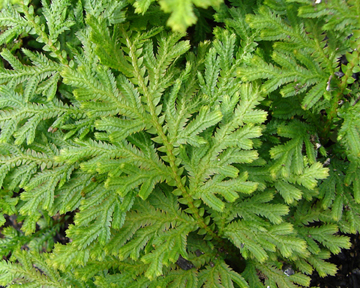
Public domain image of selaginella from wikimedia commons.

Added another genome to our sequenced plant genomes wiki, Selaginella moellendorffii, better known as as a spikemoss. Selaginella is a vascular non-seed plant which split from the lineage that gave rise to most of the plants you seed around you every day hundreds of millions of years ago. At 110 megabases, Selaginella is currently the smallest sequenced plant genome (smaller than Arabidopsis!).

Un-related to genomics, did you know plants recognizably belonging to the Selaginella genus can be found in fossils 335-350 million years old? This is a plant that has remained mostly unchanged since BEFORE dinosaurs walked the earth! This was just one of the many interesting facts I learned from reading Jo Ann Bank’s review: Selaginella 400 Million Years of Separation.

As far as I could tell the Selaginella genome paper has not yet been published (I couldn’t find it anyway). The good news is that according the the Selaginella wiki (Yes, Selaginella gets its own wiki … I kind of wish maize had a wiki… ), the paper was submitted back in August of 2009, so it’s possible that any day now this genome will move from the fun-to-play-with category into the awesome-to-publish on one.

May 15, 2010

The Problem With Metaphors

Filed under: Uncategorized — James @ 12:44 pm

Sometimes they sound so cool it takes a while to realize you’ve got no idea what it actually means:

Just as a bookcase can fit more paperbacks than hardbound books, ARMAN’s fit more scaled-down genes into the same space

From an article describing a new tiny microbe (a member of the archaea) found in abandoned acid mines. The name comes from “archaea Richmond Mine acidophilic nanoorganisms”. And I have no idea what the actual meaning is behind that metaphor.

The cells really are tiny ~1/50th the width and ~1/2500 ~1/125,000 the size of a human cell.* To put that in context, if you’ve ever seen one of those to-scale comparisons of Earth and Jupiter,  this is a substantially bigger difference.** Of course we already knew microbes had smaller cells than human cells, so the real claim to fame of this article is that these microbes are “1/3 smaller than E. coli” E. coli being a pretty average bacteria.

Now I’m sure there are actually many fascinating things about ARMAN, and fortunately I have other options to learn about those things other than the popular press. I can read the PNAS paper itself because I’m fortunate enough to be employed by an institution that pays for me to get access to the paper, and I’ve spent the last six years of my life learning the art of extracting meaning from scientific papers.

I could also just e-mail the guy in my program who works on the same acid mineshaft were these microbes were identified.

But until then… I have no idea what the difference between a softcover gene and a hardcover one is.

If your curiosity has been sparked, check out the actual paper, which looks to be an interesting read.

*Assuming both cells are spheres for ease of calculation.

**Thanks to Jeff for catching that I mixed up circles and spheres, making my original estimate of the differences in cell volume a DRASTIC underestimate. Maybe I need to institute a peer review approval policy for this site? 😉

May 11, 2010

Where the superpowers of superweeds come from

Filed under: agriculture,biofortified,Genetics,Plants — Tags: , , — James @ 11:53 am

Superman had the yellow sun of earth, spiderman had a radioactive spider-bite, but what about superweeds, where does their super power (surviving application of Round-up/glyphosate) come from?

To understand how superweeds survive, we first have to understand why normal weeds (the Jimmy Olsens and Lois Lanes of the plant world) die. <– last superhero reference of this post I promise. (more…)

May 5, 2010

Super-weeds?

Filed under: Uncategorized — James @ 4:44 pm

Long time readers will know I have serious problems with using the term superweeds to describe weeds that have resistant to a herbicide. Yes, herbicide resistant weeds are a serious issue (just like antibiotic resistant diseases), but they are ONLY a problem for people who use the herbicide in the first place. A nytimes article from a few days ago on herbicide resistant weeds, while earning a little of my ire for still calling them superweeds, makes this point amazingly concisely:

The National Research Council, which advises the federal government on scientific matters, sounded its own warning last month, saying that the emergence of resistant weeds jeopardized the substantial benefits that genetically engineered crops were providing to farmers and the environment.

The danger, if we don’t do a better job of managing resistant weeds (through strategies ranging from crop rotation to developing crops resistant to different herbicides to allow farmers to rotate between different herbicides) is that we will lose some of the environmental benefits genetic engineering is ALREADY providing. Farmers who don’t use crops genetically engineered to resist herbicides, whether they grow their crops conventionally (using other herbicides, plowing, or hand weeding to control crops) can deal just as well — or as poorly — with giant pigweeds* that are “superweeds”, as those which are not.

*Which the nytimes informs us can grow 3 inches a day under ideal conditions. In other news, that’s pretty awesome! Corn might be able to beat it unless the pigweed got a head start**, but weeds are a much more serious issue for crops like cotton and soybeans which don’t ever get as far up off the ground.

**This is entirely my own amature speculation, I’ve never had to grow corn in a production environment and the last time I was responsible for a real field of research corn, we controlled weeds the old fashioned way (long days in the sun with a hoe***) until the corn plants got big enough to hold their own.

***Everyone should really spend at least one day hoeing corn (or some other crop, I’m not particular). For a little while it’s fun and exhilarating, and by the end of the day you have a much better understanding of why very few people would ever CHOOSE a life of manual agricultural labor, whether as subsistence farmers or migrant laborers.****

****Sorry for going so crazy with nested foot-notes. Clearly I’ve been missing this style of writing more than I realized!

May 4, 2010

CoGe in the News

Filed under: Uncategorized — James @ 8:33 am

Happy Star Wars Day everyone!

I just wanted to draw your attention to a guest post by Eric Lyons over at OpenHelix. Eric is the man behind CoGe, the tool I use for most of the genomics eye candy I put up on this site, and which also makes most of my research possible.

Among other things, he’s putting out a call for more biologists to try using CoGe and provide suggestions for either new useful features or ways to make the features CoGe already has more intuitive.

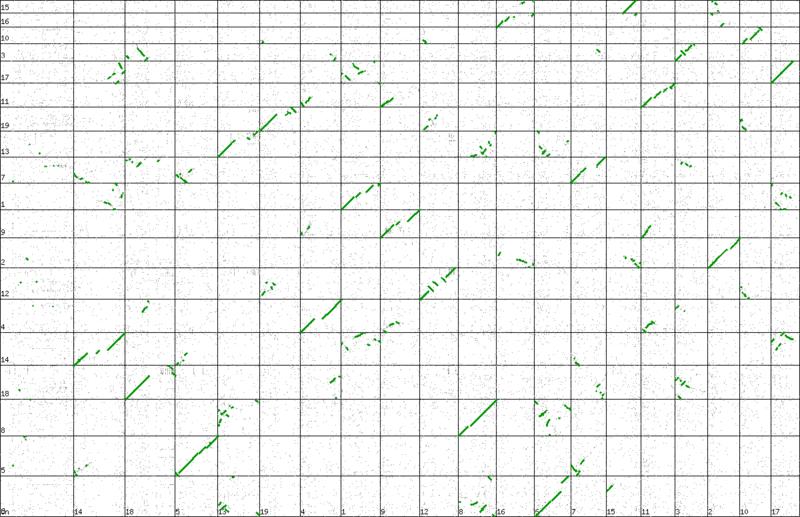
Changes between version 1 and version 2 of the grape genome. Cool, no?

April 30, 2010

The Organic Industry is Not Doomed

Filed under: Uncategorized — James @ 11:57 am

“We know it will hasten the demise–it will hasten the demise of organic farming, a rapidly developing business in this country.” – Lawrence Robbins (one of the lawyers arguing before the supreme court in the herbicide resistant alfalfa case)

As quoted here

Is there any real risk of the organic food business will be disappearing any time soon? Not so far as I can see. It really is a rapidly growing sector of agriculture,* and pollen contamination is an issue farmers have had plenty of experience dealing with long before genetic engineering ever entered the scene. If you’ve ever tasted an ear of sweetcorn that was pollinated by field corn, you know what I’m talking about.**

So here’s my question. Using only current trends (ie it’s fair to assume more genetically engineered crops are introduced in the future, but not that congress will pass a law requiring all farmers to plant them), can you make an argument for how the organic industry could be wiped out in the US, by genetic engineering or anything else?

*Whether that’s a good or a bad thing depends on whether you think the environmental benefits of organic farming outweigh the long-term downsides of defining good farming not with science, but with what feels natural.

**The majority of the corn kernels we eat are made up of the endosperm and embryo. Both of these get DNA from the mother plant (the one the ear grows on) and the father plant (the one whose tassel shed the pollen grain that fertilized the single corn silk attached to where that kernel of corn would later develop). A kernels of an ear of sweetcorn can each have different fathers, but if enough of those fathers were field corn, you’ll know it, because the father’s DNA will provide a working copy of the gene that lets corn kernels turn all that sugar that makes sweet corn sweet into starch, so your sweetcorn would’t taste sweet at all. The vast majority of the corn grown in the US is fieldcorn, yet I don’t think anyone would argue the sweetcorn industry is being hastened towards towards its immident demise. For more about the genetics of what makes sweetcorn sweet, read this discussion of the shrunken2 gene.

April 29, 2010

Almost Done Teaching

Filed under: Uncategorized — James @ 2:24 pm

I’m out in the hallway while the first of my two sections fills out their reviews of me as a GSI (graduate student instructor).

« Newer PostsOlder Posts »

Powered by WordPress