James and the Giant Corn Genetics: Studying the Source Code of Nature

December 9, 2009

Funding the Good Guys

Filed under: agriculture,Feeding the world,Politics — Tags: , — James @ 5:47 pm

Some changes are happening for CGAIR (the Consultative Group on International Agricultural Research). If you don’t know about CGAIR, they’re definitely the good guys. But don’t take my word for it. How would you classify a non-profit organization that’s been working for close to 40 years to fight hunger and poverty by improving the agricultural productivity of poor and subsistence farmers around the world. Also consider on other key fact: while plenty of people and organizations fight hungry and poverty, the effort of the CGIAR centers works.

But, like any non-profit, the work of the CGIAR centers depends on the funding they can secure. The news today is about a structural reorganization of CGIAR which, at least in theory, will make research more efficient. Previously donors who wanted a say in how their money was spent would give grants to individual researchers. Which had two undesirable consequences: (more…)

December 8, 2009

My Zygocactus is Getting Ready to Bloom

Filed under: Photo Posts,Plants — Tags: , , — James @ 11:51 am

Some background: as an exciting and awesome plant scientist as myself might be expected to maintain a wide range of plants around the house. Instead I have exactly one*, a Christmas Cactus that’s been clonally** in my family for four generations (human generations, my Christmas Cactus is only a third generation plant).

My Christmas Cactus is not happy. At my old apartment I had it on the kitchen table, where…someone… had an accident involving it and a pressure cooker. Right after we moved I left it on a windowsill with the window open and the blinds (blowing in the wind) cut into it even more. On top of all that, the new place offers only north facing windows***.

So needless to say I wasn’t expecting so much as a single flower given everything it’s been through. Which is why I was so surprised when I went to water it and discovered…
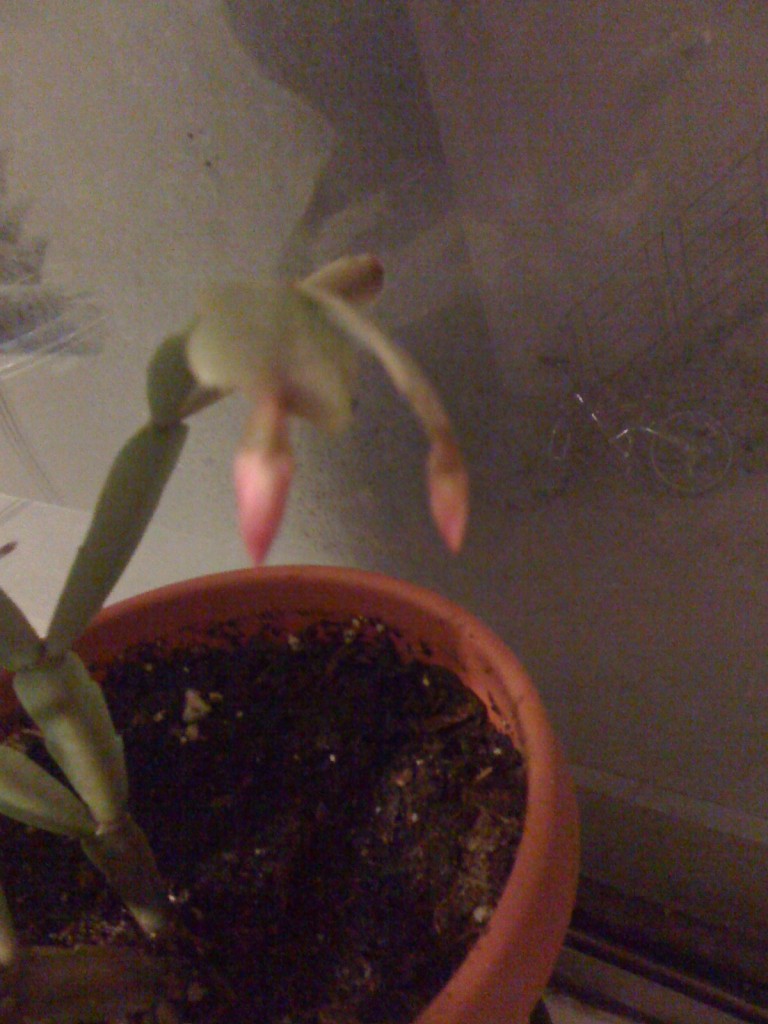
Christmas Cactus blooming... also a sample of the less than thrilling view out my bedroom window.

Christmas Cactus blooming... also a sample of the less than thrilling view out my bedroom window.

Before I rotated the plant, those two branch tips were pressed right against the window, which makes me think something like a vernalization response (temperature dependent) is involved in signaling to a Christmas Cactus that it’s time to flower. There are buds on many of the rest of the branches, but they’re still tiny.

Thanks to Mr. Subjunctive for introducing me to the name Zygocactus, even if it was in a post about how he was giving up on the (awesome sounding) name in favor of Schlumbergera.

I also want to name-drop Liza of Good to Grow. My plan is to continue following her site and use it as inspiration to increase my plant collection so by next year my Christmas Cactus won’t be so alone.

*This is what happens when you’ve moved into a new place six times times in the past six years, plus two moves of ~1000 and ~3000 miles respectively.

**The easiest way to make new Christmas cactuses is to break off several of the segments that make up one of it’s branches, put them in water to root and then plant the new plant in soil. Since the new plant is genetically identical to the old (after all it grew from a PIECE of the old plant), in other words it’s a clone. Cloning plants is much easier than cloning animals…

***When it warms up I’m planning a commando raid to sneak the poor plant onto my roommate’s balcony for a bit more sun.

BBC Frontiers on Genetically Engineered Crops

Filed under: Feeding the world,Link Posts,Politics — James @ 1:28 am

Without realizing it I’d begun to fall into the trap of thinking of European positions on genetically engineered plants mostly as they impact countries in the developing world (European donors funding Greenpeace activity in Thailand, or the threat of losing access to European markets being used to discourage the use of genetically engineered crops in Africa), so it was great to stumble across this segment on BBC Frontiers and be forcefully reminded that the position of the EU (and of it’s member nations) is not set in stone and continues to be the subject of strong debate.

The segment is available streaming from the BBC’s website and it’s a fascinating listen. (Budget ~25 minutes, the stream is a little longer, but the end is just bookkeeping and transitioning to the next show.)

If you don’t have the time to listen to the whole thing (and you really should), here are a couple of key quotes: (more…)

December 7, 2009

To Accomplish the Impossible

Filed under: Plants,Politics — James @ 8:52 am

Here’s an inspirational quote about science:

“It was believed impossible to create a blue rose, since roses lack the gene to produce the color blue. However, a Japanese company spent 14 years in research and finally succeeded in developing the world’s first blue rose. I explained to President Obama how this blue rose, which holds the meaning ‘to accomplish the impossible,’ was created and said, ‘Let us work together to accomplish the impossible.’”

-Japanese Prime Minister Yukio Hatoyama as quoted here (and boy will I feel silly if the whole story is a hoax)

“To accomplish the impossible”. When it comes to assigning meanings to flowers (as well as picking life goals), I’d call that a pretty good one.

The blue rose was actually developed by an Australian company called Florigene which has been acquired by a Japanese company called Suntory. I went into more detail about Florigene’s products here.

December 6, 2009

Sunday Links 12/6

Filed under: Link Posts — Tags: , , — James @ 12:59 pm

MAT Kinase tells the story of some of a cool, weird, (and potentially deadly) fruit created using nothing but conventional breeding techniques in Plumalmodterine.

Steve Savage has the conversation with a Greenpeace campaigner I’ve always wanted to have with the people who can constantly be found soliciting money for similar organizations on my walk to work.

Steve’s post reminded me of this awesome (and freely available article) from Plant Physiology: Forbidden Fruit: Transgenic Papaya in Thailand* which is highly recommended reading for anyone interested in genetic engineering, the developing world, and the role of NGOs like Greenpeace.

I’m considering making this a regular feature. I often read cool articles, but it feels weird to put up a post that just says “go read this” when I don’t have anything of my own to add. Anyway, the test of whether this will be a feature or a fluke will be if I remember to post another one in a week.

*I know I’d previously mentioned this in my post on virus-resistant papayas, but I think there are at least several new readers since then and I’ve been dismayed to find out how little publicity this article seems to have received when it first came out.

December 5, 2009

See the Tomorrow’s Table Seminar

Filed under: Uncategorized — James @ 12:33 am

Mary points out that, after a free registration, you can see a streaming video of Pamela and Raoul’s talking about the same issues at the Long Now Foundation.

December 4, 2009

Quick Question On Student Debt

Filed under: Fun With Numbers — Tags: — James @ 12:49 pm

Numbers in this post come from from The Project on Student Debt. I can’t vouch for their accuracy myself, but assuming they are:

Which of these numbers do you think is more informative?

  1. Among college students in Iowa graduating with debt, the average amount owed was $28,174 (73% of students graduated with debt)
  2. Among all college students who graduated in Iowa last year, the average student owed $20,567? (more…)

December 3, 2009

Make Sure Your Voice is Heard

Filed under: agriculture,Campus Life,Feeding the world,Politics — James @ 9:51 pm

Another positive side effect of extending my stay in Iowa for another week (besides having the chance to work from a room with a view), was getting the chance to see the Pamela Ronald and Raoul Adamchak give a presentation on the same themes are their book “Tomorrow’s Table” here on campus (I’ve reviewed the book itself).

Pamela Ronald is actually going to be talking in Berkeley late next month, but, in addition to a sneak peak of the presentation (which was really good) listening the the question session following their talk was a great chance to resample the perspective of the other major group involved in the debate on genetic engineering (besides anti-gmo activists, corporate public relations people, and plant scientists like me), farmers and agronomists.

What Pamela and Raoul advocate, distilled down to a single phrase, is agriculture utilizing “the best technology and the best practices.” The best technology is pretty clearly going to incorporate at least some genetically engineered traits, but the best farming practices will definitely incorporate approaches from organic agriculture. (more…)

December 2, 2009

Edible Cottonseed

Filed under: agriculture,Feeding the world,Plants — Tags: , , — James @ 1:26 am
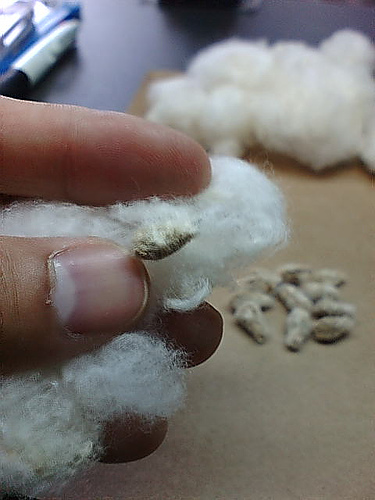
Cotton and cotton seeds photo credit: Gonzalez's tongue, Flickr (click to see photo in it's original context)

Cotton and cotton seeds photo credit: Gonzalez's tongue, Flickr (click to see photo in it's original context)

Over 102 million bales of cotton (more than 24 million tons of cotton) were grown around the world last year. I wouldn’t surprise me to hear cotton called the single most important (and widely cultivated) food crop on the face of the planet. But does it have to be a non-food crop?

Clearly no one (nor any livestock) wants to eat the cotton fibers themselves, but they aren’t the only product of the plant. After to cotton plant flowers, the cotton fibers grow around the developing seeds. The combined mixture is harvested each year, after which the seeds are removed from the cotton fibers before the cotton is baled and sold.*

The seeds of the cotton plant are full of protein and oils and since cotton is already grown as a source of fiber (and the seeds are even harvested and sorted out of the cotton fibers already) adding them to the food supply** doesn’t require any further land to be cultivated or increased input costs. Obviously there is a catch… (more…)

December 1, 2009

China’s Approval of Bt Rice Confirmed

Filed under: agriculture,Feeding the world — Tags: , , , — James @ 7:22 pm

Read today’s story from Bloomberg. I’d discussed my own thoughts when it was a story based on anonymous sources last week.

From the article:

China produces 31 percent of the world’s rice and 20 percent of its corn, U.S. Department of Agriculture data show. …[China] uses 7 percent of the world’s arable land to feed a quarter of its population.

China has only 7% of the world’s farmland yet feeds more than 1.3 billion people (and still growing). No wonder they’re investing so heavily in crop/plant science.

Another one I recently read (if it was you, sorry for not attributing it properly, the comparison just stuck in my head) was that India and Argentina are about the same size (India is about a quarter bigger) yet India must feed 30 times as many people!*

*Of course this isn’t quite a fair comparison since Argentina exports so much food to Western Europe, since those countries can afford to buy food abroad instead of focusing on increasing local production, and China and India must

« Newer Posts — Older Posts »

Powered by WordPress