James and the Giant Corn Genetics: Studying the Source Code of Nature

December 26, 2009

Name That Plant: Nondescript Root Edition

Filed under: Photo Posts,Plants — Tags: — James @ 4:31 am

Do you have any idea how long it’s been since we’ve had a name that plant post? The last one was almost a year ago on January 11th. So rather than let the tradition go a year untouched, this is an special edition of Name… that… Plant!

Can you name this root vegetable?

If you guess it correctly (and I’ve no idea if this one will be hard or easy but prior experience suggests someone will know within the first couple of comments, though on this other hand this isn’t a great picture) I’ll let you know as soon as I see the comment. If no one gets it by new year’s eve I’ll update again with the answer (and a better picture that gives it away).

This is what my part of California looked like on the Monday before Christmas! Glad I'm celebrating the holidays somewhere with snow.

December 25, 2009

I know it’s a couple of years early for me but…

Filed under: Link Posts — James @ 2:52 pm

By Jorge Cham, author of PhD comics who really does capture grad student life.

By way of The Daily Scan who in turn picked it up from The Intersection’s Sheril Kirshenbaum.

Merry Christmas

Filed under: Photo Posts,Plants — Tags: , , — James @ 5:24 am

I hope everyone is having a great holiday (even if you don’t celebrate Christmas, if you live in the US it’s hard to get much work done today).

Right before I left town to celebrate the holidays with my folks, my zygocactus decided to flower for the first time ever*. I guess it really is a christmas cactus!

Christmas cactus in bloom!

Wishing all a safe and happy holiday!

*Well since it’s been a free living plant. As previously mentioned, the plant goes back at least four human generations propagated by cuttings.

December 24, 2009

Support Sugar Beet Farmers

Filed under: agriculture,food — Tags: , , — James @ 3:24 pm

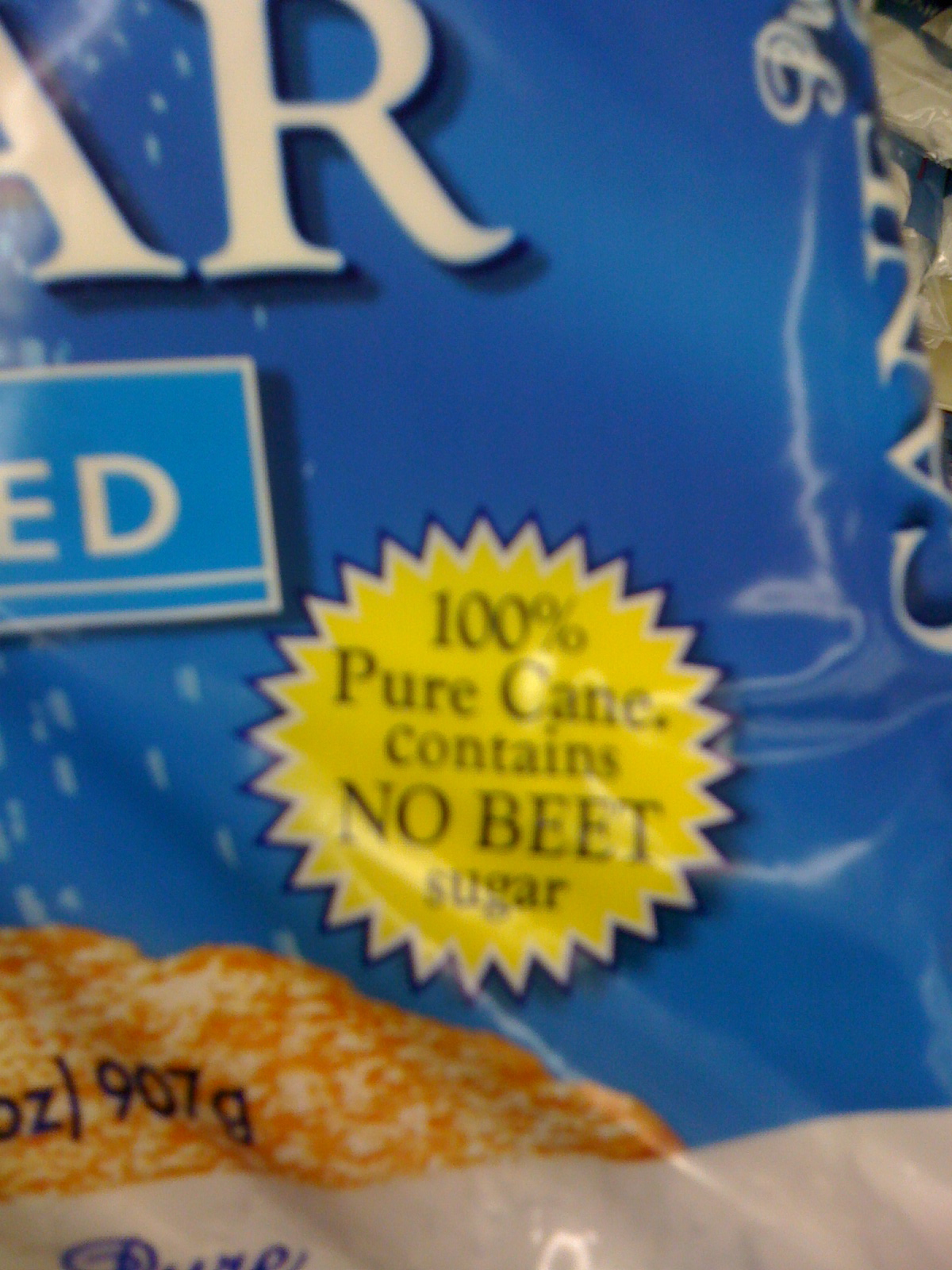
Earlier today I was sent out, through rain and fallen snow, to visit the local grocery store for various last minute cookie ingredients, including confectioner’s sugar. The only brand I could find had this prominent label:

Powdered sugar at the local grocery store

First of all I’ve never understood why people care wether a given cup of sugar come from sugar cane or sugar beets. Regardless of source, white sugar is at least 99.9 percent pure* sucrose. Sucrose is a single molecule with an exact structure that is the same regardless of source. (Like salt crystals, or de-ionized water it’s a pure substance, only one step up from elements like carbon and oxygen).

Sucrose molecule

A model of the sucrose molecule. All sucrose, regardless of source, will have this same structure. If it doesn't, it's not sucrose. Image from wikimedia and distributed under the creative commons 3.0 share alike license.

That said, I’ve never before seen a label on a bag of sugar that proudly announced what it is NOT (beet sugar). I don’t know if this is a reaction to the current publicity about herbicide resistant sugar beets, or the old feelings about the, non-existent, differences between sugars refined from different plant sources taken to their logical extreme, but either way, in this christmas of all christmases, is not the time to be kicking beet farmers when they are down. (more…)

December 19, 2009

Lack of Daily Updates

Filed under: Site Business — James @ 1:48 am

Just a quick update. I’ve been trying to keep a couple too many balls in the air, with the result that I have, unambigiously, ended my stretch of daily updates (and basically dropped off the face of the internet).

Anyway, to any loyal readers, I intend to return to daily updates either after Christmas or at the start of the new year. I’ve proven I can do it. It’s just a matter of making the time.

December 14, 2009

You Think I’m Evil… What Next?

Filed under: Link Posts — Tags: , , , — James @ 11:18 am

I’m a public sector plant biologist. Your tax dollars at work for better or worse. But even I have had similar encounters to the one Janice so accurately describes in this post I was pointed to on twitter*:

I asked what she does and she says mostly volunteer work now.  She asks me and I reply that I work in the cotton business for a company that improves seeds… its Monsanto & the seeds are called Deltapine.

There was an audible gasp, and her eyes opened so much it startled me. She said “Monsanto is evil.” This is where the stress came in. I have read this before, but the fact that I was hearing it today since I’d been making a lot of effort to stay positive seemed like a test. Really. And to have the person, who I’ve pleasantly visited with for five minutes, looking right at me like I’m evil,having just said that heard I am part of Monsanto. It was certainly a test…a test of the Janice-response system.

Seriously, how often do you call someone evil & mean it? She was dead serious.

But the moral of this post isn’t that it sucks to be a plant biologist, it’s that, as painful as it is to have someone look to in the face, and call you evil, there’s still the chance for engagement. At this point I probably would have either changed the subject or put in my iPhone earbuds and hoped the flight would be over soon, but Janice didn’t get mad, didn’t drop the subject, and it sounds like she actually managed to get the other woman to reconsider her categorical opposition to biotechnology. I highly recommend reading her whole post.

*Thanks @MikeHowie and @cornguy

December 13, 2009

Panda Genome

Filed under: biology,Genetics — Tags: , , , , — James @ 5:11 pm
Can you imagine how much easier it would be to get funding if you too worked on panda biology?

Can you imagine how much easier it would be to get funding if you too worked on panda biology?

Nature just released a pre-publication copy of a paper detailing the sequencing of the panda genome. The genome was sequenced and assembled using entirely 2nd generation sequencing technologies (specifically the Illumina sequencer) which produced reads that averaged only 53 basepairs long.*

The panda they chose was a three year old female, and they got such resolution (the average individual base pair was sequenced 73 times!) they were even able to identify individual changes in sequence between her two copies of each chromosome.** From this they were able to estimate a difference in the DNA sequence (called a SNP***) occur once every 740 bases which is almost twice the rate of humans. (more…)

December 12, 2009

The Water Chestnut

Filed under: Crop Profiles,food,Plants — Tags: — James @ 7:45 pm
Botanical illustration of Eleocharis dulcis, the Water Chestnut

Botanical illustration of Eleocharis dulcis, the Water Chestnut

The water chestnut is one of those foods I’ve eaten my whole life without knowing anything more about it than flavor and appearance (and that only because it so often shows up in frozen vegetable mixes).

The scientific name for the Water Chestnut is Eleocharis dulcis, and it’s often classified as a sedge.* It’s also a quite awesome plant. Consider:

  • The visible parts of a water chestnut plant are leafless stems that perform photosynthesis. (The water chestnut has almost completely abandoned leaves!)
  • The edible part of the plant is a botanical structure called a corm** which is a modified underground stem used by a plant to store energy (water chestnut plants are very much about stems). Not to be confused with bulbs like those of onions and garlic, which can look similar, but are instead made up mostly of leaves
  • The reason water chestnuts remain so crunchy after cooking is that their cell walls are reinforced by special phenolic compounds, the same class of molecules as capsaicin, the molecule that makes chilli peppers spicy.

The genus Eleocharis also contains species like Eleocharis vivapara which switch between C3 and C4 forms of photosynthesis depending on whether they’re grown on dry land or in swamps. The relative advantages and costs of these two different forms of photosynthesis are worth a post on their own, but I’d always assumed it was an either/or choice and didn’t realize ANY plant species could pick to use whichever system was best suited to the local environment.[citation]

Domestication: (more…)

December 11, 2009

Stalling

Filed under: evolution,Genetics,Link Posts — James @ 7:48 pm

It was a very long day at work and I have nothing interesting to tell you.

Go check out MAT Kinase and John Hawks‘s posts on how human evolution has been driven by the dietary changes of our relatively recent ancestors, farmers and herders rather than hunter-gatherers. (At least in many cases, it’s quite possible someone reading this blog can trace their ancestry back to human populations that remained hunter-gatherers into the 20th century.)

December 10, 2009

More on the Good Guys (CGIAR)

Tracked down a paper published just under a year ago in Food Policy (a peer reviewed journal). “The impact of agricultural research on productivity and poverty in sub-Saharan Africa” by Arega Alene and Ousmane Coulibaly.* 

CGIAR spending on research targeted at agriculture in Sub-Saharan Africa (178 million dollars a year in 2003) provides 1.3 million people with an escape from extreme poverty (living one dollar a day or less) every year. Simple division would indicate the agricultural research of the CGIAR centers is saving human beings from the trap of extreme poverty at a cost of just under 137 dollars per person. Of course it isn’t that simple, there are both economies of scale** and, eventually, diminishing margins of return*** to consider, but it seems the work of the CGIAR centers in Africa are big enough to have achieved those economies of scale, and, given their calculations on the elasticity on poverty to investment in agriculture, Africa is a LONG way from having to worry about diminishing marginal returns on agricultural investment.

Given the elasticity of poverty reduction to agricultural research spending they calculate (-.22) the marginal cost* of reducing poverty by another person in Sub-Saharan Africa through investments in agricultural research is only $71. (i.e. spending one billion dollars more on agricultural research would save an additional 14 million people from poverty.) This doesn’t consider the additional postive effects of improving local agriculture (for example reducing the incidence of famine).

Finally consider this quote from the paper for a sense of the work the CGIAR centers are funding and try not to feel as impressed as I do: (more…)

« Newer Posts — Older Posts »

Powered by WordPress