My spam filter has become drunk with power and is attacking innocent comments while allowing obvious spam to pass unchallenged. I’ve disabled it at least temporarily, I’m sorry if your comments have been disappearing without a trace. If you run into any other problems with the site drop an e-mail to jcs98@(this website’s URL here).
November 2, 2009
Thank You Readers
In the first two days of November jamesandthegiantcorn.com has logged more traffic than in all of August. We’ve set new views-per-week records in five of the past six weeks. I’d like to think I’d write just as much if no one read, but in all honestly, that climbing views statistic has been vital motivation more than once. It also been especially awesome to see that we’re starting to get some real discussions going in the comment sections. Thank you!
I’m going to be buckling down the next few days to wrap up an NSF fellowship application due Friday, but I’m going to keep up the pace of at least one science or technology based post per day (this doesn’t count). I’ve even developed a small Strategic Post Reserve though hopefully I won’t have to dip into it. (As I wrote this, my PI swung by to remind me my NSF research proposal isn’t the hill I should want die on.)
While I’ve got your attention, let me wish a belated happy birthday to Biofortified. Their site has been live for a year now, and as I said to them, my only compaint is that I wish they wrote even MORE. Biofortified also finished ahead by a huge margin in the Asoka Changemakers contest, so unless someone leans pretty hard on the numbers, Frank is going to be meeting with Michael Pollan!

Biofortified's mascot Frank.
Alright, cya later folks. My sciencing awaits.
Why a Monoculture of Corn isn’t like a Monoculture of Bananas
It’s a common leap when people start talking about Bananas, and how their lack of genetic diversity meant it was impossible to breed resistance to the blight that destroyed them (see more here), to then jump to condemnation of our modern, monoculture based agriculture as a fragile edifice waiting to be toppled over by the first strong breeze (disease, climate change, oil running out, whatever the disaster of the day happens to be).
Obviously I disagree. (more…)
November 1, 2009
Domestication Bottlenecks
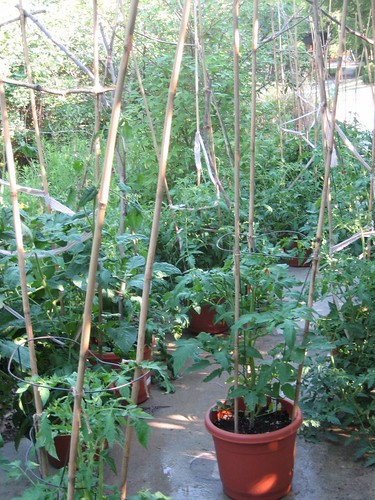
Driveway tomato garden. How much diversity do these plants contain?
Crops like tomatoes, even heirloom tomatoes, aren’t found in the wild. Domestication of crops usually involves only a relative handful of individual plants. Narrowing the species down to a few hundred (or possibly even a few dozen plants) means only a limited number of copies of each gene will be carried through and many of the variant copies of the genes present in the wild population won’t be included in that number. Keeping the population small for multiple generation reduces variability even more as by chance some rare version of genes in one generation won’t be passed to any of the offspring in the next.
Genetic bottlenecks happen in the animal world as well. Skin grafts between unrelated Cheetahs aren’t rejected because the animals are so genetically similar their immune system can’t distinguish the grafted skin as being different from its own skin. Even less fortunate are the tasmanian devils who have so little genetic diversity that they are being decimated by a transmissible cancer. After fighting with an infected devil, which has tumors on its face and neck, tiny bits of the cancer will get into an uninfected devil’s wounds, and since the immune system can’t distinguish the foreign cancer cells from the devil’s own cells, the cancer cells reproduce unchecked, the trait that makes normal cancers, produced by mutated versions of our own cells, so deadly. And the solution mentioned in the article, to save the species by protecting 200 individuals, while better than letting them all die, will sacrifice even more genetic variability by subjecting the already inbred devils to a new population (and genetic) bottleneck. (more…)
Disease Resistance and Diversity
Matt has a great new post up on The Scientist Gardener called The Myth of Monocultures. He gives talks about the PBS special on Michael Pollen’s Botany of Desire (which I still need to watch myself), addresses some misconceptions about diversity and monoculture and talks about the best way to ensure crops aren’t wiped out by pathogens that can evolved to overcome a single resistance gene:
Theoretically, it would be useful to maintain crop populations with diverse resistance genes. The industrial application of this (multilines) invovles breeding many different versions of a favorite crop variety that are identical except for their resistance genes. As appealing as this idea is, it hasn’t really worked out in the real world. The alternate approach (pyramiding) seems to be more effective. Here, many different resistance genes are combined into a single crop variety. Pests and pathogens may be able to overcome a single gene at a time, but it’s usually almost impossible to simultaneously overcome several.
Think of it like the story of the three little pigs. [spoilers ahead ;)] (more…)
October 31, 2009
Predictable Spinning of Squash
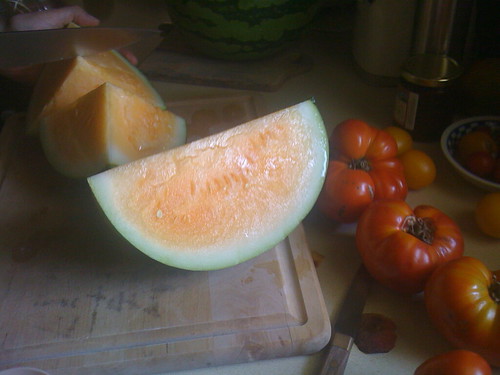
I don't have any picture of pumpkins handy, so this watermelon (and fellow cucurbit) will have to do.
What could be a more fitting topic for a Halloween post than cucurbits, the family of plants that (in addition to crops like watermelon and cucumber) include squash and pumpkins? Yeah, I know it’s a stretch.
A week ago a paper came out in PNAS (the proceedings of the national academy of sciences. A very prestigious journal, one step down from Science or Nature), that showed when an artificially inserted gene in squashes that provided virus resistance was introgressed into a wild related species it actually made them less fit. Short version: the wild squash also suffer from the virus which attacked domesticated squash but are also attacked by beetles, and the beetles prefer to eat squash without the virus. Tomorrow’s Table has a much better and more complete explanation of the research.
In that post the very first commenter predicted the result, that in this particular case a transgene (like most genes involved in domestication) was beneficial for farmers but not for wild plants, would be spun into “another failure for GMOs” when the real message is “we were worried about pollen drift, but in this case it turns out we didn’t have to be.”
He was right. (more…)
October 30, 2009
Mt. Tamalpais, Invasive Species, and Herbicides

On the side of Mt. Tamalpais in in the summer.
Mt. Tamalpais sits across the San Francisco bay from me, on a clear day you can even see it from the hills behind the Berkeley campus. Apparently, the region around Tamalpais is also home to species, especially plant species, found no where else. These local species are threatened by other, invasive, species that have been brought to northern California from all over the world. Some accidentally, but many more imported as ornamental species for private gardens.
Invasive species aren’t something I worry a lot about, but we had a great presentation in one of my classes on Tuesday by a woman who’d spent several years fighting the good fight against them across the bay.
Take French Broom, a woody shrub from the Mediterranean. California’s native habitat is quite similar to the Mediterranean climate and the species is thriving, growing so densely that it chokes out tree seedling before they can grow big enough to escape the thicket. The plant is out-competing FORESTS! And it’s also taking a bite out of the ecological niche currently occupied by alpine grasslands like the one pictured.
I like grasslands. (more…)
October 29, 2009
Crops and Colbert
I love the Colbert Report, but could somebody who knows something about agriculture and plant genetics please sit down with Stephen Colbert until he knows what he’s talking about food wise? Every so often he’ll make these incredibly uneducated jokes about food production. It’s weird to be suddenly jerked out of enjoying the episode as I remember “These guys are comedians, not experts.”
Back in April he turned the debate about Michelle Obama’s organic garden into a crack at round-up ready soybeans. Yesterday*, in the middle of a funny bit about breeding people who might actually be able to get health insurance, we got the mocking:
After all, selective breeding and genetic modification have worked miracles for our fruits, vegetables and livestock.
Yes they really have. Let’s leave genetic engineering out of the mix (after all most people having eaten a genetically engineered fruit or vegetable in their lives, unless you’re a big fan of papayas, or certain kinds of squash, and genetic engineering of livestock is way behind where we are with plants). Selective breeding of plants over thousands of years is what feeds the wold today and has for millennia. Before the advent of agriculture, which was made possible by selective breeding to domesticate plants and animals, the world supported, what, 5-10 million hunter gatherers, spread across the entire face of the globe?
Without selective breeding of crops and livestock we wouldn’t have a civilization to begin with, let alone one advanced enough to have developed not only our complex (but good) system of medicine but also our complex (and not so good) medical insurance.
I’m serious, does anyone know if there’s a way to nominate people to be interviewed on the Colbert Report? I want to nominate Pamela Ronald and Roger Beachy.
*I have to catch the Daily Show and Colbert Report the day after the fact on Hulu.
Try Ubuntu

Screen grab of Nymph my at-home Ubuntu Box. Click for fullsize.
With the latest release of Ubuntu (a flavor of Linux) open source operating systems have never been more user friendly. It’s still not for everyone, but how are you going to know whether it is for you or not if you don’t try? And trying Linux is so easy these days. After burning a CD or DVUD with the disk image downloaded from the Ubuntu website, simple restart your computer and you should be given the option to either install the OS to boot direct into Ubuntu’s version of the Linux desktop. Trying out the desktop without installing it doesn’t affect anything installed on your hard drive, your computer has just booted up from the CD. (The downsides are that reading data from external media can be slower than from the hard drive, and since the CD is read only, nothing you do in this test mode will be remembered after a restart.) But starting up your computer this way isn’t a long term solution, it’s just a way to find out whether Linux is something you’d be interested in installing and learning to use. If you do, the CD will walk you through installing Linux next to your existing OS so you’ll have the option to start your computer into either one.
Why should you try Ubuntu? There are all sorts of philosophical big picture arguments people make about open source software (software than can be freely redistributed or modified by anyone), and another set of pragmatic ones about never having to pay for another version of Windows or Mac OS X, let alone Microsoft Office, and Ubuntu’s safty from viruses and spyware. There’s even a third set based on personal hatred of Microsoft and everything it represents. I can get behind all of those, but for me, there’s a single compelling reason to spend at least part of every day using Ubuntu or another version of Linux.
On a window’s computer the gap between being a computer user and a computer programmer is a vast and gapping chasm. Trying to jump from a person who uses computer programs to someone who writes them takes a lot of knowledge, and it takes a long time before what you learn about programming actually helps you accomplish useful tasks. On Macs the gap is narrower, and that’s where I first started writing code. In Linux the gap is the smallest of all. People can even drift across it accidentially. And the code you start writing is immediately useful for things like data analysis.
Linux breeds superusers. People who don’t just use programs others have written, but when confronted with a question no one else has ever asked, or a problem no one else has ever addressed, can still get their computers to do what they want. Two guys who came in the same year as me started using linux this past summer for the first time for a two week python course (only one week of which was useful, I was there). Now one of them is writing C++ code for his phylogenetics project, and the other programs his lab’s liquid handling robot. Both are getting things down in weeks or months that without the ability to write their own code would take a big part of their entire doctoral research (or just wouldn’t even have been considered feasible in the first place.) As in any field, once you know enough to get results, learning begins to snowball and before you know it you’re doing things you never thought you’d be able. (more…)
October 28, 2009
I’m disappointed in the Des Moines Register
Normally the Des Moines Register is pretty good about getting their facts straight when it comes to crop breeding and genetic engineering. After all of the major newspapers left in this country, their readership is probably the most likely to catch any slip ups.
So I was surprised when reading a story about a small breeder who’d developed soybeans resistant to nematodes to find this:
The seed industry has battled the parasite in the usual way, with genetically modified seeds designed to resist the parasites. As has happened in the age of genetic engineering, the nematodes* gradually evolve to overcome the biotech resistances.
I have no idea where Dan Piller, the author of this piece, got this information. Unlike new media outlets like blogs, newspapers don’t ever have to cite sources, the assumption being that they’re reliable enough to be taken at their word. But I defy the Register in general, Dan Piller in particular, or any of the people already linking to this piece to name a seed company currently selling seed genetically engineered to resist nematodes. It would be a very beneficial trait. When I worked at the Danforth Center, Chris Taylor was studying how nematodes interact with their prey. I’m also told Monsanto recently announced that they have been working on nematode resistance using RNAi (though I couldn’t find any internet sources to back that up). Even so that’s a trait still in development, and this article gives the impression transgenic nematode resistance has already been commercially sold and failed.
That said, nematode resistant soybeans would be a Very Good Thing™ regardless of whether the resistance is the result of transgenes or conventional breeding. Nematodes are a big problem for yield. However, whether the trait is transgenic or non-transgenic, any single resistance trait will eventually be overcome by the continued evolution of whatever organism it is protecting against. One of my plant breeding instructors in undergrad said that a good resistance allele (talking about conventional breeding, not genetic engineering) is one that protects a crop from a disease or pest for a decade after the trait becomes widely available.
That window can be stretched with proper care. Bt crops that resist against specific insect pests have been on the market for ~15 years and the development of resistant insects has been slowed planting refuges of non-resistant crops.
*Nematodes are microscopic worms that live in the soil. They latch onto the roots of crops (and other plants) and suck out nutrients. They’re the plant equivalent of tapeworms. With all that energy going to feed parasites, plants have less energy left to … well produce food for us humans.