James and the Giant Corn Genetics: Studying the Source Code of Nature

October 27, 2009

Banana Biology

When I was giving my lecture to on phylogeny and tetraploidies, I found out not everyone knows why bananas don’t have seeds.

The reason the bananas we eat don’t have seeds is that they are all sterile. A long time ago the Cavendish bananas first came into being when a tetraploid banana (that is a plant that has four copies of every chromosome instead of the normal two) mated with a normal diploid banana. The result, a banana with three copies of every chromosome couldn’t mate or produce seeds. One of the steps in making reproductive cells (the analog of human sperm and egg cells) is the even dividing of a plant’s chromosomes into two reproductive cells.* Normal diploid cells can easily divide into two cells (one copy of each chromosome in each cell), tetraploid plants can divide the same way (two copies of each chromosome in each cell). Hexaploid, three copies in each and so on. Odd numbers of chromosomes don’t work. The plants can’t successfully make the cells it needs to reproduce, if it can’t reproduce it can’t make seeds, and that is why bananas (or seedless watermelons) don’t have seeds. (more…)
October 26, 2009

Time to Eat The Dog

Filed under: Feeding the world,Fun With Numbers — James @ 11:37 am

With a title like Time to Eat the Dog? A real guide to sustainable living you can sure a book will sell a lot of copies, and earn the authors a fair bit of hatemail at the same time. The book itself by Robert and Brenda Vale received mixed reviews on amazon.uk. But what about the premise of the book? (Which isn’t actually that dogs make great food sources, but rather that keeping carnivores as pets is a major resource burden.)

In an article on new scientist, the authors calculate that it takes .84 hectares (that’s over 2 acres!) of farmland to support a medium sized dog. Larger dogs like German Shepherds have a footprint of 1.1 hectares (2.7 acres)  Through some calculations they then start comparing the impact of a dog to various cars, but that hinges on assigning energy production values to farmland, which in my opinion is the weak link in their calculation.

So why not look at how dog ownership compares to the land required to feed a human being? (more…)

October 25, 2009

Bananas: The Original Not-From-Here Fruit

Filed under: agriculture,Crop Profiles,food,Plants — Tags: , , — James @ 6:03 pm
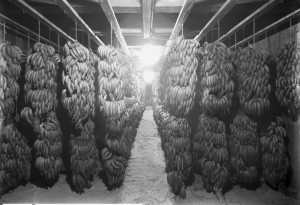
A banana storage room in Salt Lake City in 1913.

A banana storage room in Salt Lake City in 1913.

As early as 1905 the United States was importing 33 million bunches of bananas a year. Bunches averaged more than 100 individual bananas. Billions of bananas were being consumed in America before the Ford Model-T car was first produced. (more…)

October 24, 2009

Microbial Art

Filed under: biology,Link Posts — James @ 5:45 pm

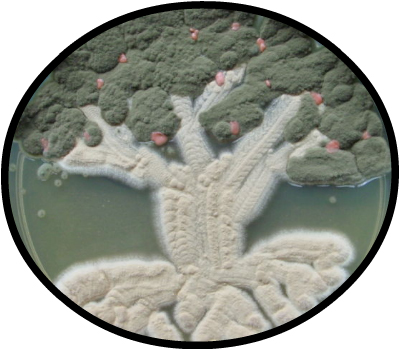
Check out some of the gorgeous art people can make in petri dishes.

Clearly the people who create these have far steadier hands than I do when it comes to smearing out colonies.

by Niall Hamilton

by Niall Hamilton

Relaunched Tomorrow’s Table

Filed under: Link Posts — James @ 4:58 pm

Yesterday I linked to Pamela Ronald’s relaunched blog at Scienceblogs. There are over one hundred million blogs on the web (and that’s already an outdated number). Many are abandoned, as for all intents and purposed jamesandthegiantcorn was this summer, but even so, simply getting heard over the background noise is a struggle.

Becoming part of a popular and well known community greatly increases those odds of having the voice to each a substantial audience. It’s been a real treat to follow the discussions the posts of the new Tomorrow’s Table have already launched. I highly recommend checking them out.

I can also speak from personal experience in saying that increased traffic and comments definitely make updating a blog more exciting, which in turn leads to more interesting, and just plain more, updates. And so-on in one of those wonderful positive feedback cycles. Given that I expect we’ll be hearing a lot more from Tomorrow’s Table in the future.

I also hope it is ok that I am a litte envious. Will just have to use it as a motivation to work even harder both here and on my actual research.

October 23, 2009

Putting Prejudice over Science

Filed under: agriculture,Link Posts,Politics — Tags: , , , — James @ 3:56 pm

I read this when it came out, but it was before I’d restarted the site full time, and Pamela Ronald restarted the discussion over on scienceblogs today. Back in May the USDA posted a report on their website about how allowing genetically engineered crops to be certified as organic would have positive environmental effects.

Needless to say the organic movement was not pleased, and the report has since been pulled from the website. Now I previously celebrated the idea that the Obama administration was going to let organic and biotech go head to head and take the best parts of both. I’m confident in the benefits of genetic engineering when people judge the technology based on the data instead of preconceived opinions.

Making reports disappear because they step on the toes of well connected interest groups is not letting the data speak for itself.

h/t’s to Tomorrows Table and Biofortified.

And hey, if you’re willing to spend 10 minutes you can register and vote for Biofortified in the Ashoka Changemakers Contest. There’s a good chance you’ll help win $1500 to support a website fighting the good fight to correct the misinformation about genetic engineering, but even more importantly from my perspective, winning this contest means the guy on the left (yes he’s wearing a corn cob patterned t-shirt) will get a chance to meet with Michael Pollen. There’s also a stuffed corn cob with glasses in the picture.

October 22, 2009

Agriculture in Popular Culture: CSI Miami

Filed under: biology,Entertainment — Tags: — James @ 7:54 pm

Sorry for missing my daily post yesterday. Still trying to get over whatever I caught last week.

Last week, 13.3 million people watched CSI Miami in prime-time. That’s more people than live in the state Illinois. It doesn’t consider reruns, Tivo recordings, or piracy.** So to the untrained eye (mine), it seems likely the show is making enough money to hire a scientific consultant or two. Clearly the untrained eye is wrong and budgets are so tight that that the expense of finding someone who’d taken intro biology anytime in the past fifteen years was far too much. As demonstrated in this weeks episode “Bad Seed.”

Before I continue, let me say first of all I’m not one of CSI:Miami’s regular viewers. They don’t have to worry about losing me as a fan. I never was one. Second, I don’t get angry when shows like Fringe or the SyFy (<–that’s really how they spell their name now) Channel’s disaster and/or monster movie of the week completely mangle science. They are, and acknowledge themselves to be, science fiction. Shows based on fictional science. On the other hand, shows such as the CSI and Law&Order families set fictional stories in what, we are supposed to believe is, the  real world. As such, the burden on them to get their facts straight is much stronger.

A burden the writers of CSI Miami clearly can’t be bothered to live up to. (Oh, if it wasn’t obvious already, spoilers ahead). (more…)

October 20, 2009

Grafting

Filed under: agriculture,Plants — Tags: , , , , , , — James @ 1:13 am
Grafted Apple Tree

Grafted Apple Tree

Imagine if all it took to replace a lost leg was to put another leg against the amputation site, tie up the wound and let the two grow together. We can do that with plants! We’ve been doing it for thousands of years and it is an important part of crops production for woody plants (think fruit trees).

The technique is called grafting and it really is almost that simple. A branch or stalk* from one plant is cut and attached to another plant of the same or a related species**, making sure to line up the vascular tissue*** of the cut branch and host plant. That connection is covered with grafting wax or grafting compound which keeps the exposed ends of the cuts from drying out which would stress or kill the cells. (more…)

October 19, 2009

Welcome PATSP readers

Filed under: Link Posts — James @ 9:46 am

If you’re hitting the site for the first time welcome. Look around and make yourself at home. I’ve been meaning to highlight a couple of my more popular posts and I figured your visit was a good occasion to do so:

GM tomatoes don’t taste bad

Why Wheat is Losing Out in the Era of Modern Crop Breeding

and

A Defense of Hybrids

October 18, 2009

Stalled…

Filed under: Uncategorized — Tags: — James @ 10:05 pm

Fortunately xkcd has an even more genius comic than usual today.

« Newer Posts — Older Posts »

Powered by WordPress