James and the Giant Corn Genetics: Studying the Source Code of Nature

October 17, 2009

Bill Gates at the World Food Prize

Filed under: agriculture,Link Posts — Tags: , , , — James @ 1:07 pm

If you have a few minutes, take the time to either watch or read the speech Bill Gates delivered at the World Food Prize in Des Moines. While I don’t care for the operating system that made him a multi-multi-billionaire, I don’t think anyone can argue that he is doing more good with his wealth than any other member of the superwealthy.

Africa is the only place where per capita cereal yields have been flat over the last 25 years. The average farmer in sub-Saharan Africa gets just over half a ton of cereal per acre. An Indian farmer gets twice that; a Chinese farmer, four times that; an American farmer; five times that. (more…)

October 16, 2009

World Food Prize

Filed under: agriculture,Feeding the world,Plants — James @ 6:41 pm
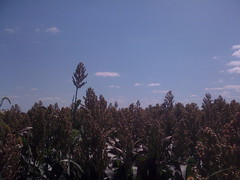
Iowa sorghum field.

Iowa sorghum field.

The World Food Prize, an award set up by Norman Borlaug to honor others who fought against hunger, was held in Des Moines this week.* The prize went to Gebisa Ejeta, an Ethopian-American plant breeder and geneticist, who developed new breeds of sorghum that increase yields as much as fourfold.

His sorghum breeds deal better with drought, a trait that will become only more important around the world as competition for fresh water increases. Perhaps even more importantly though, they are resistant to striga**, a parasitic weed that attaches to the roots of crops, drawing off nutrients and severely decreasing yield (20-80% less than uninfected fields). Each plant produces tens of thousands of tiny seeds than can lie dormant in the soil for up to twenty years waiting for the best moment to strike, so once a field is infected with striga, it isn’t going away. The common name for striga is witchweed which fits the species perfectly. Striga resistant sorghum is a very good thing.

My appreciation and congratulations go out to Gebisa Ejeta.

*This is the first time the prize has been awarded since Dr. Borlaug passed away.

**On the more basic research side, the study of striga lead to the discovery of a new class of plant signaling molecules strigolactones.

Pictures of an Extinct Flower

Filed under: Link Posts — James @ 2:41 pm

The people over at plant-talk have a post up with gorgeous pictures taken in 1982 of a Ghost Orchid, a English wildflower that hasn’t been seen in 23 years and was recently declared extinct.

October 15, 2009

Spoiled with Perfect Produce

From teddlerus on flickr

From teddleruss on flickr

Matt over at The Scientist Gardener put up an important post a couple of days ago where he related his own experiences touring a lettuce field:

The crop wasn’t in great shape, but we anticipated a decent harvest. We were shocked to learn that the field had already been harvested! Hundreds of perfectly edible heads lay all around us, left unpicked because they didn’t meet stringent appearance standards for consumer acceptance.

How big an issue imperfection is varies from crop to crop. For a crop like oranges it isn’t one at all, since there’s plenty of demand for orange juice, a use that don’t require visually attractive fruit. Now when it comes to something like cauliflower, or as Matt was talking about lettuce, there’s very little demand for anything other than fresh, whole produce. The rest just goes to waste rotting in fields.

In America it is an issue of consumer preference, and I couldn’t find any statistics on wastage to imperfect fruit. In the European Union it was until recently a matter of government policy. Twenty percent of produce was being thrown away for not meeting government size and shape criteria. This summer the restrictions were removed from 26 type of fruit and vegetables which was expected to cause price drops of up to 40% for some kinds of fresh produce. You could imagine something similar would happen in the US if we as consumers didn’t demand perfect fruits and vegetables, making healthy (if odd looking) food more affordable for everyone.

I’m not sure if there’s a call to action here. Just something to be aware of.

October 14, 2009

Potato Breeding

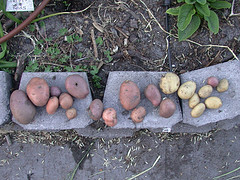
Unfortunately the purple potatoes aren't a Cornell Breed

Unfortunately these purple potatoes aren't one of the Cornell breeds

A lot of people may not share my enthusiasm for the potato genome, hopefully you all enjoy eating potatoes. The stereotype of potatoes is lots of boring sameness one identical to the next.* Reality, as usual, is much more complicated. Tens of thousands of cultivars can still be found in the South American regions where potatoes were first domesticated. In America, breeders are constantly working to bring in desirable traits from those (often really cool looking) breeds and even wild relatives of the potato. They face both genetic barriers (species barriers are bad enough normally, but trying to introgress genes across a tetraploidy can be a mess) and consumer acceptance ones.

This was driven home in a story at the NYtimes about Cornell potato breeders who have developed breeds which grow much better in upstate New York, but run into problems because the potatoes look and taste different than the couple of varieties of potatoes consumers and restaurants are used to (most notably Idaho grown Russet Burbanks**). Cornell Extension has been working on overcoming that barrier providing the potatoes to restaurants and, in what I think is a genius move, culinary schools throughout the region.

If you happen to visit New York farmers markets take a moment to ask sellers about the breeds of potatoes they have for sale.*** The potatoes covered in the story are Salem, Eva (both white potatoes), Lehigh, Keuka Gold (yellow breeds), Adirondack Blue and Adirondack Red (both of which are just the color you’d expect from the name.) Purple potatoes in particular just look really cool, see image above.

*There was a saying about accepting differences that I vaguely remember from a childhood TV show, something along the lines of “People aren’t the same like potatoes, and that’s a good thing because potatoes are boring.”

**The Russett Burbank was developed by a truck gardener outside of New York City called Luther Burbank in the 1800s who was initially inspired to become involved in plant breeding by Charles Darwin’s 1868 The Variation of Animals and Plants Under Domestication. He later moved to California where he became famous plant breeder and, among other things championed the practice of grafting (connecting a cutting from one plant (usually a tree) to the stem of another, which, if done properly grows the two together and the cutting will grow flower and produce fruit like it would normally) a practice at the time condemned as unnatural. <– This info from Mendel in the Kitchen by Nina Fedoroff and Nancy Brown a great resource

***In fact, whenever you’re buying directly from a farmer, if you get a chance, ask about the breed of whatever you’re buying. More often than you’d expect there’s an interesting story about why he or she is growing that particular breed and where it came from.

October 13, 2009

Potato Genome!

Filed under: biology,Plants,research stories — Tags: , , , , , — James @ 7:26 pm
4000695954_3feb96f136_m
Photo from graibeard

Sort of anyway. What was released was a pre-publication scaffold of the genome. A final, published, version might include more primary sequence data, will have fewer gaps, and most importantly of all, people will be able publish their own work which draws on the potato genome.

Overall I have mixed feelings on the current practice of releasing genome sequences prior to publication. As someone who does comparative genomics, having access to more genomes is great, but the agreements they’re released under severely limit how they can be used in publications prior to the publication of the genome paper itself (which can be a LONG time).

Within the grasses four genomes are available (Maize(corn), Sorghum, Rice and Brachypodium) however only two of them, Rice and Sorghum, are published. Any paper making use of whole genome analysis of all four cannot be published before the Maize and Brachy papers come out (hopefully before the end of this year!).

That said having even a rough draft of the potato genome is cool. Potato is a great plant for a lot of reasons. Potatoes are the fourth staple crop (behind only rice, maize and wheat) that provided enough food for people to build civilizations and probably the most important non-grass crop in the world. Currently there are no GMO-potatoes on the market, as I mentioned here. Domesticated potatoes are tetraploid and rarely breed true (their offspring aren’t much like the parents).* And I still owe it a post of its own.

Another reason to be interested in potatoes are is the family tree of the species. Potato can claim tomatoes, eggplant, and deadly nightshade as close relatives.** That whole group of species belongs to a different branch of the family tree of plants (the Asterids) from the early non-grass genomes (Arabidopsis, Papaya, and Grape) which were all in a group called the Rosids. These two groups are responsible for a lot of the diversity of species within the Eudicots*** so it’s good we are starting to starting to see Asterid genomes.

*Potatoes grown from seed not sharing many characteristics with their parents is why most cultivation of potatoes is done by planting pieces of potatoes instead of seed. The plant that sprouts out of a potato is genetically identical to the plant that grew the potato. It’s a clone. Apples actually face a similar issue with apple seeds not being much like their parents. That’s why breeds of apples are propagated by grafting. A breeder cuts off a piece of a branch from one tree and carefully connects it to the stem of an unrelated apple tree. If the graft is done properly the branch will grow, flower, and produce fruit just as it would normally. So all apples of the same variety (say Gala, Macintosh, or my new favorite Cripps Pink) are clones of each other.

**The obvious family resemblance to deadly nightshade was one of the reasons Europeans originally believed tomatoes and potatoes to be toxic when they were introduced from the Americas.

***For a sense of how Eudicots fit into the family tree of all plants, check out Phylogeny of Pineapple, a further explanation of awesomeness
October 12, 2009

Could someone check my math?

Filed under: Feeding the world,Fun With Numbers — James @ 9:33 pm
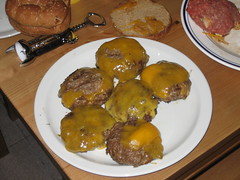
Deliciousness

Deliciousness

Per capita meat consumption in America is 124.8 kilos per year. Which is ~275 pounds per year, 5.3 pounds per week, and almost exactly 3/4 of a pound per day.

That seems like a lot to me. I mean that’s three quarter-pound hamburgers each and every day. On occasion I’ve hit twice that, maybe thrice in a single meal. But when I say on occasion, I mean every once in a long while. I can’t believe the occasional, delicious, burger binge would bring my average up to three quarters of a pound on a per-day basis.

Have I made an obvious math error? Am I eating less like the average American than I realize? Anyone have more insight into this statistic?

Internet Scale Data

Filed under: Computers and Coding — James @ 9:12 am

I’m pretty proud of my eight core* workstation. But then I picked up the New York Times this morning** and found out I’m in fact behind the times:

For the most part, university students have used rather modest computing systems to support their studies. They are learning to collect and manipulate information on personal computers or what are known as clusters, where computer servers are cabled together to form a larger computer. But even these machines fail to churn through enough data to really challenge and train a young mind meant to ponder the mega-scale problems of tomorrow.

“If they imprint on these small systems, that becomes their frame of reference and what they’re always thinking about.”

Analyzing huge data sets is only going to get more important in the future, especially in biology. (more…)

October 11, 2009

Snow on Corn

Filed under: Link Posts — Tags: , , , — James @ 3:41 am

Speaking of strange weather: Check out the first photo of the latest post on Plants are the Strangest People. I’m not used to seeing corn getting snowed on until the plants have already turned brown. But that’s exactly what happened in Iowa.

This will be my second winter without snow (except visits to see family in the rest of the country). It feels very unnatural. Hope I still remember how to drive in it (and shovel it) once I leave Berkeley.

Note that it’s 3:40 AM in the west coast. My weekend of decompression and vegetation is going well.

October 10, 2009

Really Strange Looking Clouds

Filed under: Link Posts — Tags: , , — James @ 11:25 pm

It looks like something photoshopped but apparently not, a whole new class of clouds created by ripples between different layers of air in the sky. Like the the dust storm in sydney, real weather can be strange enough to look like something out of a movie with modern CGI.

One question I have from the write up:

In hill country from Iowa to the Scottish Highlands…

Where is this Iowan hill country?

« Newer Posts — Older Posts »

Powered by WordPress