James and the Giant Corn Genetics: Studying the Source Code of Nature

March 14, 2010

And the list gets better!

Filed under: genomics,Site Business — James @ 4:02 pm

Based on e-mails and responses to my previous post I’ve made the following additions to the sequenced plant genomes page:

  • Added an entry on Columbine, a member of an early diverging group of eudicots. As far as I can tell this sequence is currently unreleased, but from the JGI website it looks like the initial assembly is already complete, so if you know of a way for people to get ahold of that let me know.
  • Added an entry on the Castor Bean. The sequencing group has released a 4x coverage genome assembly. (The castor bean is the source of the deadly toxin ricin, and is not grown in the US, we import our castor oil from other countries.)
  • Split the entry on Arabidopsis into “Arabidopsis species and allies“. This gives the Arabidopsis lyrata its own heading, and will be important since there are another 7 species from the Arabidopsis genus and its close relatives in the JGI sequencing pipeline.
  • Added an entry on v2 of the date palm genome generated by Weill Cornell Medical College in Qatar. This definitely should still be considered an “in progress” genome, but at least until the banana genome comes out it’s the best non-grass monocot genome available.
  • Added an entry on the genome of Physcomitrella patens, which, as a moss, is the descendant of an evolutionary lineage that split from all the other genomes I’ve listed on the page around 450 million years ago.
  • Added the recently announced sunflower genome project to the list of planned, in-progress, and private genome efforts. (Apparently the genome of the cultivated sunflower is more 3 gigabases. Bigger than corn!) That’ll be a cool genome to see when it comes out.
  • Added information on the woodland strawberry genome project, which aims to have an assembled genome of Fragaria vesca by sometime this year. You may remember the woodland strawberry genome from the mix up back in January.
  • Added the various groups that have announced they have private genome sequences of the oil palm genome to the same section.

Particular thanks to Greg, Jeff, and Eric whose suggestions where behind most of these additions.

Completely unrelated, you may have noticed I switched the RSS feed back to full length entries. I recently tried out Google Reader (I’m way behind the times I know), and it is SO MUCH nicer to see the full entries there than have to click through from a brief summary. The downside, as I know from previous experiences, is that when I send out the full entries by RSS I get a lot less traffic.

I don’t earn any income from traffic to this site, but it is a nice feeling to know people are reading and enjoying something I wrote, and I have no way of tracking how many people (if any) read an article from the RSS feed.

Anyway I’ll keep sending out full entries for at least the next week (I expect I’ll be too busy to worry about ego stroking traffic statistics until at least a week from Tuesday.)

March 13, 2010

Sequenced Plant Genomes

Filed under: genomics,Plants,research stories — James @ 7:13 pm

Libe slope in Ithaca, NY. Behind you are student dorms. At the top of the hill, campus starts. Photo: foreverdigital, flickr (click to see in original context)

When I was an undergraduate, there were exactly two sequenced plant genomes, rice and arabidopsis. And sure maybe I didn’t have to walk “ten miles to school, barefoot, in the snow, uphill, both ways”* the one way I did have to walk uphill (sometimes in the snow but always with shoes), was very uphill. But where was I?

Oh yeah, plant genome sequences. Kids getting into plant genomics these days don’t realize how easy they’ve got it. By my count (which may be low but I’m getting to that) there are ten published plant genomes, with several more unpublished genomes that are available in various states of completion, and lots more on the way.

Which brings me to what I was doing yesterday instead of writing an update for this website: trying to document the published plant genomes, the unpublished genomes that are available, and which new genomes we can expect to see published in the near future.

Please, if you find mistakes or know of additional flowering plant genomes I should mention, let me know! jcs98 (@) jamesandthegiantcorn.com.

If you don’t work in biology, it might be interesting to see which plants have sequenced genomes and how they’re related to each other.

*An explanation of this phrase.

March 11, 2010

Chromosomes and Ploidy at PATSP

Filed under: Link Posts — James @ 10:09 am

Mr Subjunctive who writes a really fun site for plant lovers and amateur to professional horticulturalists (who I’m pretty sure are also plant lovers or they would have gone into another field), set out to write a post on Phalaenopsis (a kind of orchid*).

I started this off with really good intentions, but quickly wound up on weird tangents, and then some of the tangents had tangents, and then at some point I looked up and saw that I’d written 2000 words without ever getting to how you’re supposed to take care of them. So if you’re here to find out how to actually grow Phalaenopsis, you’ll want to skip on ahead to Part II (which will post next Wednesday). Otherwise, read on.

Briefly, he covers chromosomes, the sex chromosomes of humans, weird changes in chromosomes numbers from changes in ploidy (have one or more extra copies of each chromosome) and aneuploidy (having more or less copies of individual chromosomes than normal) and some of the advantages and disadvantages of working with such plants. All while staying easily readable (something I can never seem to do once I get into talking about science).

Anyway, the point of this entry can be summed up in two words:

Go. Read.

And if you like it, check out his List: House Plants You’ll Be Growing During the Zombie Apocalypse of 2014

*Orchids are monocots (the group of species that grasses also belong to, along with pineapples, bananas and all sorts of other cool plants), so I start out biased in their favor.

March 10, 2010

Yield of Arabidopsis

Filed under: Fun With Numbers — Tags: , , — James @ 2:05 pm

Arabidopsis thaliana.

Arabidopsis thaliana is a plant which though its small size, possession of the first sequenced plant genome (released in 2000 four years before the complete human genome), and short generation time* has become a common sight in plant biology labs around the world. From an applied standpoint, the main problem with Arabidopsis research is that, like any model organizism, sometimes biologists discover things that are broadly applicable to the plant world (including important crop species, from apricots to zuccinnis) and sometimes their discoveries turn out to be specific to arabidopsis and some of its close relatives.

Since Arabidopsis is probably now the most studied plant on the planet, could we cut out the middle-man and simply grow fields of arabidopsis? You’re about to become one of the few people who knows the answer to that question. (more…)

Food Nostalgia

Filed under: Link Posts — James @ 1:20 am

James McWilliams, writing at the nytimes, makes the point that the idealizing the diets of generations past has been going on for at least 150 years. Michael Pollan’s rule: “Don’t eat anything your great-grandmother wouldn’t recognize as food” loses some of its effectiveness when you picture all four* of your great grandmothers (who were probably alive in the era of the world wars) idealizing the diets of diet of civil war era american, and so on.

h/t to Greed, Green, and Grains.

GG&G is well worth checking out in its own right. On this particular subject Michael Roberts, the blog’s author, makes the point that just because nostalgia for the foods of the past isn’t a new development, doesn’t mean there aren’t real problems with the food we eat today.

There are real problems with the ways we produce and consume food in this country. (And a whole separate set of problems in other parts of the world.) But by over-idealizing the food our great grandparents ate we’re looking for the answers to today’s problems in the past, when the real answers to the problems we face can be found (you guessed it) in the future.

Which is not to say we can’t learn from the mistakes and successes of the past. I just don’t think it’d be a good trade to exchange my diet for that of my great grandmother (any of the four).

*Four great-grandmothers (eight great-grandparents!), but consider that if we go back ten generations (perhaps an average of 250 years) we’re each descended from over 1000 people. (1024 assuming your family tree was completely free of inter-marriage).

March 9, 2010

Wow!

Filed under: biology,Campus Life,Genetics,genomics — Tags: , , — James @ 2:56 pm

Who could have predicted maize geneticists would be so interested in maize genes? The entry I posted last night on Purple plant1 and Colored aleurone1 easily received more traffic in its first day on the site (it’s still got a long way to go before it catches long term readership attractors like water chestnuts and the NIPGR tomatoes), than any entry since the heady days of the maize genome release back in November.

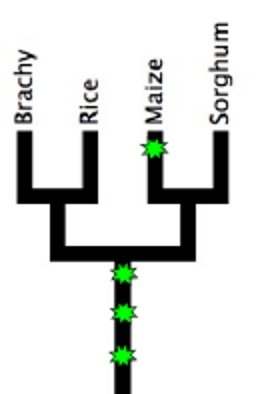
The relationships of the four grass species with sequenced genomes. The branches are NOT to scale with how long ago the species split apart. Green stars represent whole genome duplications. The most important one to notice in the one in the ancestry of maize/corn. That duplication means that every region in sorghum, rice, or brachypodium is equivalent to two different places in the maize genome, one descended from each of the two copies of the genome that existed after the duplication.

And this morning the dataset I drew that example from, 464 classical maize genes mapped onto the maize genome assembly plus syntenic orthologs in up to four grass species: sorghum, rice, brachypodium, and the other region of the maize genome created by the maize whole genome duplication (technically syntenic homeologs since we started in maize to begin with, by the principle is the same), went out to the maize genetics community (thank you MaizeGDB!).

A postdoc in our lab tells me more people have visited CoGe today than any day on record (and we hit that mark before noon!).

Anyway, thank you guys, it’s great to feel appreciated!

March 8, 2010

Scientific Posters

Filed under: Campus Life — Tags: , , — James @ 11:29 pm

I’m involved in the designing of two posters my lab will be taking to the maize meeting in a weeks time. What are scientific posters?

A cross between a very short paper and a very short, on demand, research seminar, a poster is a dozen square feet of scientific data. We grad students cobble together some figures describing the data we’ve painstakingly acquired though months of long days and nights in lab*, hang our poster a scientific conference and spend hours hovering nearby, ready to explain our research to anyone who seems even marginally interested.

Probably the most important role of posters is that designing them gets us thinking about the questions our research (what we actually do all day) is really trying to answer and how to communicate our results to people who don’t specialize in those exact same questions. A trap that I often catch myself falling into.

As for the value of posters as a real method of scientific communication… it’s best not to set your expectations too high:

The best general advice I can give a first-time poster constructor is to describe the circumstances in which a poster will eventually be viewed: a hot, congested room filled with people who are there primarily to socialize, not to look at posters. Because poster sessions are often concurrent with the “wine and beer” mixer, chaos is further increased by hundreds of uninhibited graduate students staggering around hitting on each other. It’s not a pretty sight.

And it gets worse: meeting organizers will invariably sandwich your poster between two posters that are infinitely more entertaining, such as “Teaching house cats to perform cold fusion” and “Mating preferences in extraordinarily adorable red pandas.”

Words that were comforting to read when I first started stressing out about never having put together a scientific poster before. (And just to be clear, I’m not saying posters can’t be very effective methods of communicating science, only that the worst case scenario for a poster is that it gets ignored. The worst case scenario for a paper is it comes back with a rejection notice and horrible reviews, and the absolute worst case scenario for a scientific talk is, I suppose, heckling followed by a mass walk out. My point is, by comparison, designing a poster should be a low stress activity.)

That said, I think we’ve got some interesting data to present, so if you’re going to be at the maize meeting next week and are willing to risk my inexperience with designing scientific posters, be sure to stop by poster #31 or #39.

The two posters discuss, respectively, the way extra copies of genes are lost from the genomes of plants following how genome duplications, and a project where we’ve identified equivalent genes between up to five grass genomes (which would be quite the trick since only four grass species have sequenced genomes, but since maize has its own whole genome duplication we count it twice) based on the conserved order of genes along chromosomes (synteny).

*At least that’s usually what ends up on posters. I can’t wait to find out what interesting stuff ends up on the Biofortified poster (#167)

Two classical maize genes, synteny, and the mystery of the missing gene

Filed under: biology,Genetics,genomics,Plants — Tags: , , , , , , — James @ 12:50 pm

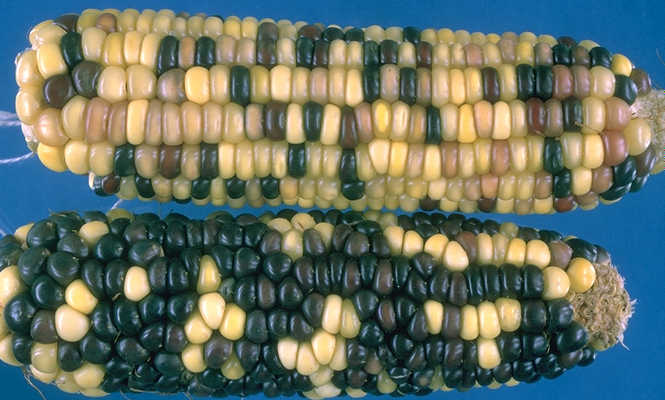
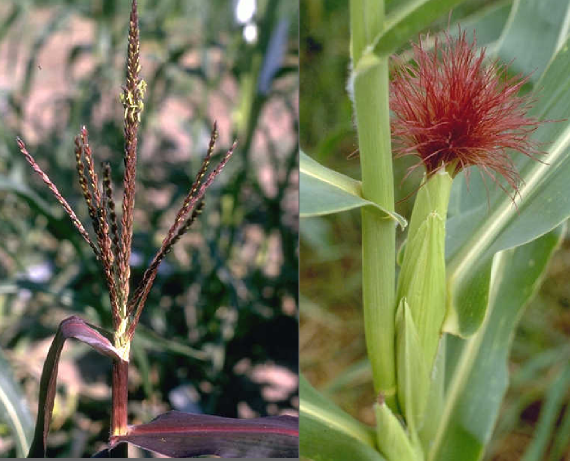
Colored aleurone1 and Purple plant1 are both genes with long histories in maize research and are involved in the regulation of anthocyanin biosynthesis.The mutant version of purple plant1 does exactly what it sounds like. (In the proper genetic background) it has plants producing anthocyanin (a purple plant pigment) everywhere, resulting in purple plants. The mutant form of colored aleurone1 was identified from a mutant that changed the color of individual corn kernels. Guess which of these two classic maize mutants made it into the top 15 most published on genes in maize, and which fell barely short.

Ears segregating for the colored aleurone mutant phenotype. Image courtesy of MG Neuffer via MaizeGDB.

Purple plant1's phenotype is highly variable depending on the genetic background the mutant is in. Images courtesy of MG Neuffer via MaizeGDB.

The two genes are also duplicates (homeologs) resulting from the maize whole genome duplication. From the picture below you can also see both the two genes and the regions they are in match up to single regions in rice and sorghum, two grasses that haven’t gone though a whole genome duplication since the great radiation of grass species that took place an estimated 50 million years ago (well after dinosaurs stopped walking the earth). (more…)

March 7, 2010

The Hair Shirt Fallacy

Filed under: Politics — James @ 8:07 pm

Kids are told to eat their vegetables because, even though they taste bad, because vegetables are good for them. They are told they can’t have ice cream every night, even though it tastes good, because ice cream is bad for them. The danger arrises when people generalize that rule, that if it’s pleasant it’s bad for you, and if you don’t like it it must be good for you. (more…)

March 3, 2010

Oliva Judson’s Salute to Grasses

Filed under: biology,evolution,Genetics,Plants — Tags: , , , , — James @ 2:33 pm

People who can actually get the general public interested in science are almost as rare as hen’s teeth.* One of those gifted scientist-communicators is Olivia Judson, an english evolutionary biologist who sometimes writes a column for the nytimes and published an interesting/hilarious pop-science book titled: Dr. Tatiana’s Sex Advice to All Creation: The Definitive Guide to the Evolutionary Biology of Sex.**

I mention all this to explain why I was so excited to learn that her post this week sings the praises of a group of species near and dear to my heart, the grasses. The whole post is definitely worth a read. Even if you don’t learn something you didn’t already know, read it as a source of inspiration for telling OTHER people how cool grasses are. And the closing is truly excellent:

We usually talk of our domestication of grasses, and the ways in which we have evolved them: we have made plants with bigger, more nutritious seeds that don’t fall to the ground, for example.But their effect on us has been far more profound. Our domestication of grasses, 10,000 years ago or so, allowed the building of the first cities, and marks the start of civilization as we know it. Grasses thus enabled the flowering of a new kind of evolution, a kind not seen before in the history of life: the evolution of human culture.

Some of the comments are heart warming to read as well, although a bunch of people have fallen prey to the maize/corn confusion. (Explained in detail here)

*Speaking of cool science that most of the general public doesn’t know about: We’ve known for more than four years that mutations of the gene talpid2 in chickens cause chicken embyros to develop teeth, something we thought birds had lost the ability to do 60-80 million years ago (around the same time grass was bursting onto the world stage.) Don’t worry too much about getting bitten by a sabertoothed turkey, the toothed embryos have other problems that mean they don’t survive.

**There’s also a three-part video series based on the book that I can best describe as … odd.

« Newer PostsOlder Posts »

Powered by WordPress