James and the Giant Corn Genetics: Studying the Source Code of Nature

March 2, 2010

The Most Studied Genes of Maize (and why we love kernel phenotypes)

Filed under: Genetics,Plant breeding,Plants — Tags: , , , , , — James @ 12:41 pm

Unique citations determined from papered linked to from MaizeGDB gene locus pages. Images of c1 and y1 segregating years by Gerald Neuffer and made available through MaizeGDB.
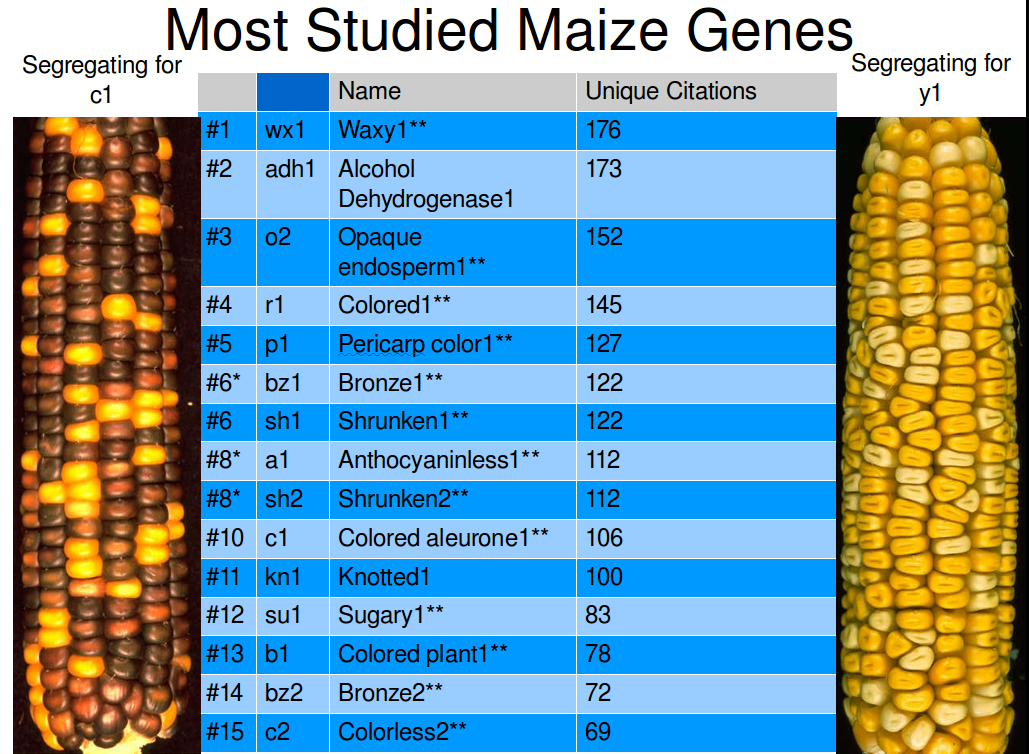
* = tied for number of citations

** = some mutant alleles have kernel phenotypes.

If you want to become one of the famous mutant corn genes, it helps if you have an effect that is visible in corn kernels instead of only from fully grown plants.

And here is why:

  • A geneticist could determine that the version of c1 that creates yellow kernels is recessive to the version that creates purple kernels just from looking at the ear of corn on left.
  • Furthermore, they could tell you that both the male parent (the plant that provided the pollen) and the female parent (the plant on which the ear of corn grew) were both heteryzygous for the c1 genes (they each had one dominant version of the genes and one recessive version), and therefore the corn kernels the parent plants were grown from were both purple.
  • They would know with certainty that all of the yellow kernels contain two recessive versions of the c1 gene.
  • While they couldn’t predict with absolute certainty whether a specific purple corn kernel on that ear carried two dominant versions of the c1 gene or one dominant and one recessive version, they would know there was a 1/3 chance that kernel has two dominant copies, and a 2/3 chance it had one dominant and one recessive copy.
  • That geneticist could make all sorts of predictions about what ears would look like in future generations depending on what colors of corn kernels were planted and which plants were mated with each other.

All this from a single picture of an ear of corn. For a phenotype seen in corn plants but not in kernels (like Knotted1), a geneticist would have to plant a row or more of corn seeds from an ear and examine the growing plants to get the same quantity of information.

And that is why mutations with kernel phenotypes have been so popular over a century of maize genetics research.
February 27, 2010

Corn Smut

Filed under: food,Plants — Tags: , , , — James @ 12:13 pm

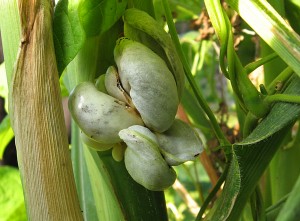
Corn Smut photo: oceandesetoiles, flickr (click to see photo in its original context)

And no that doesn’t mean corn pornography*. Corn smut, or Ustilago maydis, is a fungus that infects corn plants. It’s an old acquantance from my days working in the field. We always used to tell the new hires that corn smut was a rare delicacy in some countries (as we’d been told ourselves), but this was in the days before iPhones so until recently I never actually checked on this bit of received wisdom.

Turns out this particular bit of knowledge was true:

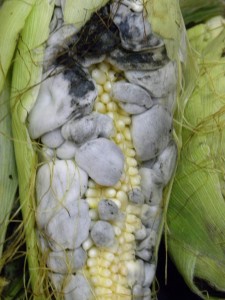
The immature galls, gathered two to three weeks after an ear of corn is infected, still retain moisture and, when cooked, have a flavor described as mushroom-like, sweet, savory, woody, and earthy.

More corn smut. Photo: moskatexugo, flickr (click to see photo in its original context)

I haven’t been able to figure out what the trade off in nutrition is between the ear of corn that is produced by a normal plant and the fungal galls that can be harvested from a plant infected with corn smut. I’d imagine corn smut provides more (and more complete) protein than an ear of corn (assuming corn smut is nutritionally similar to mushrooms.) But what’s the comparison in number of calories? The fungus is certainly sold at a higher price pound for pound.

My renewed interest in corn smut comes courtesy of a new paper** that came out in PLoS Biology describing how the fungus steals energy from infected corn plants without triggering the corn’s usual anti-fungal defenses. It’s an interesting read, you can check out the paper itself since PLoS Biology is open access, or Diane Kelley’s summary at “Science Made Cool.”

I’d seen a number of talks recently about another fungal parasite, powdery mildew in Arabidopsis, but somehow it’s much easier to focus on this stuff now that I can connect it back to corn. Even mammalian systems can be interesting*** once the make that connection.

*Please PLEASE don’t let that phrase start showing up in the search terms people use to find my site!

**Wahl R, Wippel K, Goos S, Kämper J, Sauer N (2010) A Novel High-Affinity Sucrose Transporter Is Required for Virulence of the Plant Pathogen Ustilago maydis. PLoS Biol 8(2): e1000303. doi:10.1371/journal.pbio.1000303

***The talk I’m practicing for Monday actually uses an example of a pheromone receptor in new world monkeys that was lost 23 million years ago in old world monkeys (including us humans).

February 26, 2010

The Sacrifices People Make For Science

Filed under: Campus Life — James @ 4:03 pm

Just to give you a sense what Macro Island looks like. photo: John Walker, flickr. (click photo to see in original context)

My heart bleeds for those poor scientists forced to spend the week at Marco Island for the Advances in Genome Biology and Technology conference. Not only do they have to put up with temperatures in the 60s (~20 C) and views like the one attached, but consider the grueling workload they labor under even after the sun goes down. (Excerpt from coverage by the Daily Scan):

The real marathon, though, came Thursday night with an increasingly competitive host of vendors vying to throw the best party. As far as Daily Scan can remember, you’d have to go back to the heady days of 2002 or so to see this conference with such participation from vendors, who have to be especially creative now that there’s no exhibit hall. Life Technologies and Caliper hosted parties showing off their new instruments, while Complete Genomics and Ion Torrent offered plenty of opportunity to schmooze with fellow attendees. Friday night we’re expecting fireworks (not the metaphorical kind) from Pacific Biosciences.

One MORE reason pineapples are awesome

Filed under: Uncategorized — Tags: — James @ 10:00 am

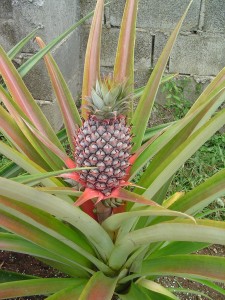
Pineapple plant. photo: CameliaTWU, flickr (click photo to see in original context)

Pineapples use CAM photosynthesis. Normally plants have to open tiny holes in their leaves (called stomata) during the day to let in carbon dioxide that they use during photosynthesis. The problem they face is that when they’re letting carbon-dioxide in, plants also let water out.

CAM plants get around this water loss by collecting all their carbon dioxide at night (when it’s not as hot so they lose less water when they open their stomata) and storing it within their leaves until they need it during the day. This allows them to be much more efficient with water than normal plants (ones carry out plain old vanilla C3 photosynthesis.*)

Why do pineapple plants need to be so frugal when it comes to water? The fact that pineapples are native to paraguay and southern brazil is repeated across the internet, but as you can imagine, that description covers a wide range of climates and habitats some of which are much drier than others. Clearly more research on the subject is called for on my part.

The fact that pineapples do CAM photosynthesis came up in a discussion with another guy in my lab where we discussed the fact that pineapples would make an excellent comparison for grass genomes** and have a reasonably small genome at ~500 megabases***, half the size of the recently published soybean and sorghum genomes and less than a quarter the size of the maize genome.

With all these new third generation sequencing technologies coming out in 2010, hopefully someone will sequence the pineapple genome. If not, maybe the cost of sequencing will drop enough while I’m in grad school that I can sequence the genome myself ( a guy can dream).

For more on my long running admiration for pineapple (second only to my appreciation of corn itself):

Why Pineapples are Awesome.

Phylogeny of Pineapple, an further explanation of awesomeness.

*Let the record reflect that corn does C4 photosynthesis, which another awesome variation on the standard system of photosynthesis.

**In addition to both pineapple  and grasses being monocots, they’re in the same order of plants, Poales, as grasses. The first non-grass monocot to be sequenced will almost certainly be the banana (in fact the process as already begun), but while bananas are monocots they belong to a different order Zingiberales (which includes spice plants like ginger, cardamom, and tumeric).

***526 Megabases as cited in Patterson AH, Freeling M, Sasaki, T “Grains of Knowledge” Genome Research 10.1101/gr.3725905

February 25, 2010

Ion Torrent Sequencing

Filed under: genomics — Tags: , — James @ 12:31 am

I know absolutely nothing about their technology (they’ve been playing things much closer to their chests than Pacific Biosystems), but they just announced they’d start delivering their machines by the end of this year and that they’ll reveal the principles of their new technology in a talk on Saturday.

Marco Island, Florida (where the Advances in Genome Biology and Technology conference is being held) is certainly the place to be this week.

Greg Baute’s optimistic predictions about the year 2010 in sequencing may prove more accurate than my own pessimism yet.

February 24, 2010

The Map Is Hopefully Fixed Now

Filed under: Uncategorized — James @ 9:45 am

WordPress keeps stripping the GoogleMaps embedding code out of the post, but if you go back to the previous entry the map should be visible.

Map of the Places That Get the First PacBio Sequencers

Filed under: genomics — Tags: , — James @ 1:13 am

In all honesty, I don’t know how big a difference Pacific Biosystem’s technology* will make to genomics. I doubt anyone can until the machines are actually in use by sequencing centers and people can start to make judgements about how they behave under real life conditions. How much sequence can actually be produced per day or per dollar? How long will the reads actually get? What sort of sequencing errors are most common with the technology and how common are they?

But now I know the people who will be the first to find out the answers to these questions. Today (yesterday by the time this is scheduled to publish) Pacific Biosystem’s announced where the first ten of their new sequencing machines will be going:

View Pacific Biosystems Sequencers in a larger map (click the markers to see the names of the institutions receiving the sequencers)

(more…)

February 23, 2010

Science Confessions

Filed under: Campus Life — James @ 1:51 am

If you haven’t already, check out the hilarious/sad hash-tag on twitter #scienceconfessions.

A few that caught my eye:

SFriedScientist: I believe PCR works better if I wear a specific hat and pet the thermocycler#scienceconfessions

Mod_Scientist: Cried in the cold room… on more than one occasion. #scienceconfessions

ToasterSunshine: I’ve gotten stuck behind the -80C freezer.#scienceconfessions

Lost_Marbles: Almost got swept into the Caribbean Sea at 15 while collecting snails for science. Never wanted to do field work again #scienceconfessions

February 22, 2010

I’m done grading midterms

Filed under: Uncategorized — James @ 9:25 pm

FREEDOM!!!!

Of course this is Berkeley, so mid-terms come twice a semester.

This is the other reason I’ve had so little time to post lately.

How many maize/corn genes have actually been studied? (Not a lot)

Filed under: Genetics,Plants,research stories — Tags: , , , , — James @ 4:42 pm

When the maize genome paper came out last November (see the summary of this blog’s maize day coverage) it included information on 32,690 genes within the maize genome.  These were the genes which the researchers involved in sequencing the genome were very confident really were genes. And by themselves those 30,000+ genes put the maize genome way ahead of our own. Of course EVERY plant genome ever sequenced has contained more genes than we do, so you’d think by now this wouldn’t be news any more. We’re not the most genetically complex creatures on the planet, and we’ll just have to learn to live with that fact.

But where was I? Oh yeah, gene counts. 32,690 high confidence genes*. Of those, how many have been studied individually? (more…)

« Newer PostsOlder Posts »

Powered by WordPress