There was a recent paper in Science about the mapping of the Artemisia annua genome. I’ve seen several people interpret this as another genome sequence. It’s hard to blame anyone for this confusion given headlines like “Scientists map the maize genome!” to describe the sequencing of the maize genome. So what’s the difference between a sequenced genome and a mapped genome? I’m glad you asked! (more…)
January 19, 2010
January 14, 2010
January 12, 2010
Strawberry Genome Sequenced (Correction included)
After already needing to correct this post, I must now invalidate the whole thing. Seems I’ve been taken in by a premature press release that was turned into reliable sounding articles on news sites and was then picked up by blogs like mine that took the those sites to be credible sources. It’s a big mess. ::sigh::
Among the many things I’m currently missing at the Plant and Animal Genome conference, in addition to an update on the banana genome I’ve just learned (thanks to Mary over at OpenHelix) that the sequencing of the woodland strawberry genome has been completed!
I don’t know yet if the sequence has been released to the public yet. Either way I can’t find the sequence so I can’t yet comment on the quality of the sequence, or any ancient duplications in the lineage (though we already know it must share the ancient hexaploidy of the rosids, possible all eudicots).
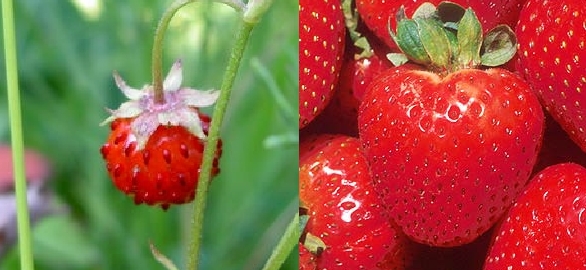
Wild diploid strawberry (left) and domesticated octoploid strawberry (right)
What we do know is that modern domesticated strawberries are octoploid, the result of two recent whole genome duplications, but the woodland strawberry doesn’t have any duplications modern enough to be obvious from cytogenetics, visually looking at chromosomes.
Sequencing a genome is a complicated process but it started out with the work of Janet Slovin, a USDA scientist who created the inbred line* used in sequencing and seems to be the front woman from the project (Janet was kind enough to comment and point out the original article was misleading on this point, check out the link she included as well!), she’s quoted in the linked article.
And if you know how I can get my hands on the sequence please PLEASE, drop me a line at jcs98 (at) jamesandthegiantcorn (dot) com.
January 1, 2010
Feeding birds on a large scale can lead to speciation?
From The Hindu:
Humans are inadvertently manipulating bird genetics by innocently providing birds with feeders in winter, according to findings by German researchers. Over less than 30 generations, birds visiting British and European gardens in winter have evolved different-shaped wings and beaks, the scientists say.
In time, they could eventually become a distinct species. The birds breed side-by-side in the same Central European forests, but began to follow different winter migration routes after some discovered rich pickings from humans in Britain.
Eventually they divided into two reproductively separate groups. One continued to fly south for the winter, migrating to Spain to forage for olives and other fruits. The other got into the habit of flying a shorter distance north-west to Britain, where bird-lovers fed them.
If you’re interested and with journal access, here is the scientific paper the story is based on (from current biology).
December 30, 2009
Why I’m so Excited About the Banana Genome

The single most consumed fruit in America, yet in the tropics this bananas starchy relatives play an even more vital role in feeding whole nations.
At the Plant and Animal Genome Conference next month (which I really wish I was going to), there will be a workshop on banana genomics, but from the abstract submitted by Carine Charron (h/t to Jeremy at the Agricultural Biodiversity Weblog) I learned that:
The sequencing phase will be completed in early 2010 and automatic annotation will take place during the first semester of 2010.
Why is sequencing the banana genome important? Three reasons: (more…)
December 13, 2009
Panda Genome
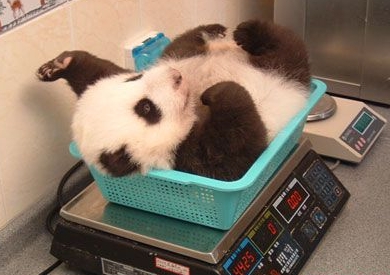
Can you imagine how much easier it would be to get funding if you too worked on panda biology?
Nature just released a pre-publication copy of a paper detailing the sequencing of the panda genome. The genome was sequenced and assembled using entirely 2nd generation sequencing technologies (specifically the Illumina sequencer) which produced reads that averaged only 53 basepairs long.*
The panda they chose was a three year old female, and they got such resolution (the average individual base pair was sequenced 73 times!) they were even able to identify individual changes in sequence between her two copies of each chromosome.** From this they were able to estimate a difference in the DNA sequence (called a SNP***) occur once every 740 bases which is almost twice the rate of humans. (more…)
December 11, 2009
Stalling
It was a very long day at work and I have nothing interesting to tell you.
Go check out MAT Kinase and John Hawks‘s posts on how human evolution has been driven by the dietary changes of our relatively recent ancestors, farmers and herders rather than hunter-gatherers. (At least in many cases, it’s quite possible someone reading this blog can trace their ancestry back to human populations that remained hunter-gatherers into the 20th century.)
November 23, 2009
The Domestication of Maize
Twenty thousand years ago, not a single crop species existed in its current form. Almost* every bite of food you eat today is the result huge amounts of human artificial selection, both unconsciously and intentionally by farmers and plant breeders. Sometimes the obvious changes are minor, for example between wild and domesticated strawberries:
Wild strawberry (left) and domesticated strawberry (right)
Clearly one of the major traits early strawberry growers selected for was bigger fruits. Which makes sense since it takes about the same amount of time an effort to pick a strawberry either way, but if you’re picking the ones on the right you’ll have more pounds of fruit picked at the end of the day.
But even in this case, the similarity in form hides major changes at the genome left. Strawberries went through two whole genome duplications during domestication (looks like it’s more complicated than I made it sound see comments), so each of the cells in the strawberries on the right contain eight copies of each chromosome, while the strawberry on the left contains the more standard two copies of each chromosome.
On the other end of the spectrum is maize. (more…)
November 21, 2009
Of course plants are more genetically complex!
Let’s remember back to a time before the human genome project published it’s first draft assembly in 2001. The genome of C. elegans a tiny nematode had already been published with ~20,000 genes. The C. elegans genome is one 1/30 the size of the human genome and the tiny worms are so small that biologists have mapped the developmental fate of every single cell in their bodies (an adult C. elegans has exactly 959 or 1031 cells depending on gender), whereas the human body contains tens of trillions. How many genes would you guess humans have?
Estimates at the time ranged from 40,000 to 150,000 genes. (more…)
November 20, 2009
Maize: The Genome Sequence Itself
The corn genome is ~2.4 gigabases (2.4 billion As, Ts, Cs, and Gs) divided among ten chromosomes. The genome of sorghum, the most closely related species with a sequences genome to maize, is also divided into ten chromosomes, but it’s only less than 800 megabases long, approximately a third the size of maize.
What accounts for the size different? Well since their divergence, maize went through a whole genome duplication, doubling it’s genome to twenty chromosomes (which have since been reduced to ten again, as pieces of chromosomes broke apart and stuck to each other*). Since then a bunch of deletions have also occurred, so only sometimes like 20-30% of the genes from the ancestor of maize and sorghum can still be found in both duplicated regions. Clearly the genome duplication of maize is not responsibly (or at least not solely responsible) for the the enormous size of the maize genome. (more…)