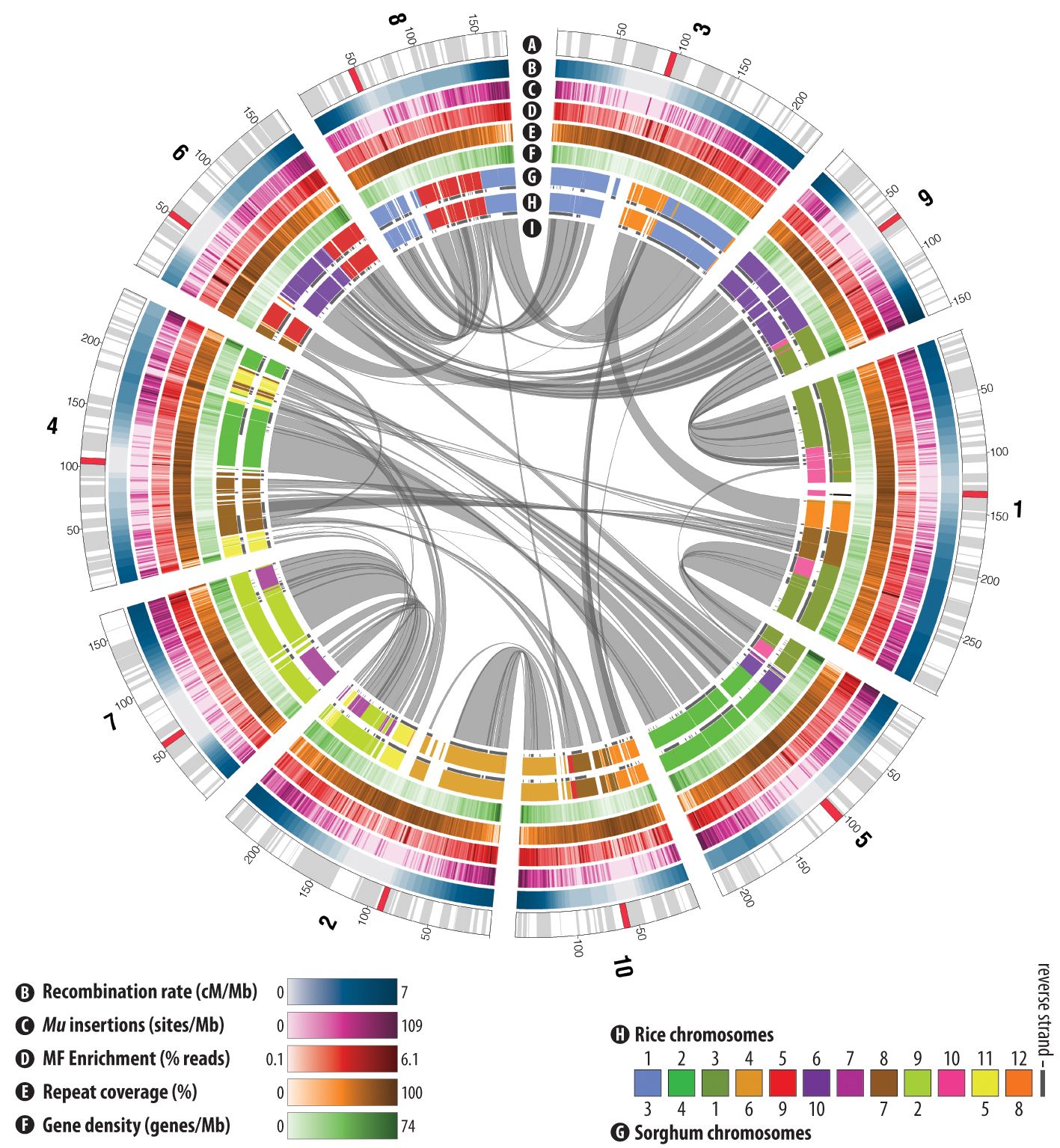
Looking at the maize genome paper in isolation it’d be easy to wonder what all the fuss was about. The paper itself is only four pages long with (plus a page of citations), with two figures, and as awesome as figure 1 is (and it really is very, VERY awesome), it doesn’t seem like an lot for a project that represents the work of more than 150 authors over four years. But the real fruits of the maize genome project are the sequences that can be found on either maizesequence.org or maizegdb.org and additional exciting research it is already enabling. And as the result of a quirk the way genome sequence is released to the research community, we can already get a sense of some of that other research. (more…)
November 20, 2009
November 19, 2009
Corn Genome
So I was mixed up and didn’t think this could be publically mentioned until tomorrow, but the finalized corn genome has come out. Edited this link to point to the ISU coverage which seems to be more detailed than the release from Wash U. If Wash U can mention it, so can I. Expect tomorrow to be a day of corn here at Jamesandthegiantcorn (though it would have been more fun if I could had started the day of corn before this news was publically announced.)
Lots of corn … and maybe some genomics. Consider yourselves forwarned!
November 9, 2009
Genetically Engineered Crops: Canola
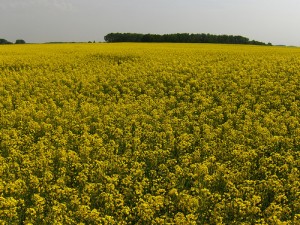
Field of Canola in Bloom. Photo: Joe Shlabotnik, flickr (click photo to view Joe's photostream)
Scientific name: Brassica napus
Genetically Engineered Traits: Herbicide Resistance.
Details of Genetic Engineering:
Two companies have produced canola that is resistant to different herbicides.
Monsanto sells canola (Roundup Ready canola) that is resistant to glyphosate, an herbicide monsanto sells under the brand name Roundup and lots of other companies sell under lots of other brand names since the herbicide itself recently came off patent (the resistance trait is still under patent.)
Bayer sells canola (Liberty Link canola) that resists the completely different, if similar sounding herbicide, glufosinate. Glufosinate is sold under a number of brand names (including, you guessed it, Liberty), but I wasn’t able to figure out whether or not it is still under patent.
About Canola:
Derived from the name “Canadian Oil” canola is an oilseed plant also known as rapeseed. The name change came in the 1970s when conventional breeding (this was approx. two decades before the first genetically engineered plants hit the market) created plants with healthier oil and without the bitter taste , and presumably someone to majored in advertising suggested that selling “Rape Oil” would be a good way to go bankrupt.
Two companies have produced canola that is resistant to different herbicides.
Monsanto sells canola (Roundup Ready canola) that is resistant to glyphosate, an herbicide Monsanto sells under the brand name Roundup and lots of other companies sell under lots of other brand names since the herbicide itself recently came off patent (the resistance trait is still under patent.)
Bayer sells canola (Liberty Link canola) that resists the completely different, if similar sounding herbicide, glufosinate. Glufosinate is sold under a number of brand names (including, you guessed it, Liberty), but I wasn’t able to figure out whether or not it is still under patent.
About Canola:
Derived from the name “Canadian Oil” canola is breed of the oilseed crop rapeseed. The name change came in the 1970s when conventional breeding (this was approx. two decades before the first genetically engineered plants hit the market) created plants with healthier oil and without the bitter taste people associated with rapeseed oil, and presumably someone to majored in advertising suggested that selling “Rape Oil” would be a good way to go bankrupt.
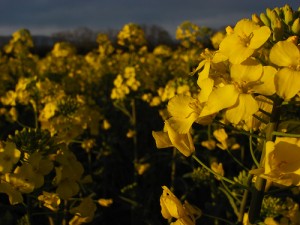
Close up of Canola Flowers. Photo: Pollobarca2, flickr (click photo to see pollobarca2's photostream)
Rapeseed (the USDA doesn’t break out separate statistics for Canola) was the third biggest source of vegetable oils around the world in 2008-2009 at 20.5 million metric tons, coming in behind only soybeans and oil palms.
Canola is the main oil I use in my own cooking. Canola is apparently one of the healthier sources of vegetable oils, but the two things I most appreciate about it are the high smoke point (it’s harder to burn the oil itself*), and low cost. Last time I checked I was able to find a 48 oz bottle of canola oil for 2.99 which was better than local prices for peanut or corn oil. (Olive oil of course comes in much smaller containers that cost $10 or more, not at all suitable for graduate students.)
*Good for someone who is both as indifferent a cook, and as easily distracted as I am.
November 8, 2009
Biological Control of Western Corn Rootworms

Face of the Enemy: Adult Western Corn Rootworm chewing on the silks of a corn ear. Picture from wikimedia, apparently in the public domain
This post discusses the paper Degenhardt, J et al. (2009) “Restoring a maize root signal that attracts insect-killing nematodes to control a major pest”
The Western Corn Rootworm (which as you can see from the picture to the right are not actually worms) is estimated to cost farmers in the US alone one billion dollars a year in lost yield and pest control measures. The newly hatched larva begin feeding on root hairs and as they get bigger start attacking the main roots of a corn plant. The damage to the roots from the feeding itself is exacerbated by the open wounds becoming infected. The loss of roots both stresses the plant and reduces yield by decreasing the plant’s supply of nutrients and water, but also makes it much more vulnerable to lodging (getting blown down by a gust of wind). Oh, and did I mention the adults like to feed on the corn plant’s reproductive tissues, decreasing yield even further?
Rootworms are one of the pests controlled by plants genetically engineered to express BT a protein taken from organic agriculture. Without it, the 1 billion dollar price tag for rootworm damage and control would be even higher. But this isn’t an article about bt, it’s an article about how some corn already knows how to call for help when rootworms attack.
Rootworm larva may feast on the roots of maize, but they are in turn eaten by some species of nematodes.* And it turns out some kinds of corn know how to attract nematodes, and when they’re under attack by rootworms they do just that. The nematodes get a delicious meal of rootworms and the corn plant gets to keep more of its roots intact.
How do corn plants attract their, unintentional, nematode defenders? (more…)
November 7, 2009
Figure from my Research Proposal
“My budget…triples the number of National Science Foundation graduate research fellowships. This program was created as part of the space race five decades ago. In the decades since, it’s remained largely the same size –- even as the numbers of students who seek these fellowships has skyrocketed. We ought to be supporting these young people who are pursuing scientific careers, not putting obstacles in their path.” – President Obama
I’m still feeling brain dead after the final push for submitting.
Speaking of NSF, here’s the one figure I managed to shoehorn into my research proposal.
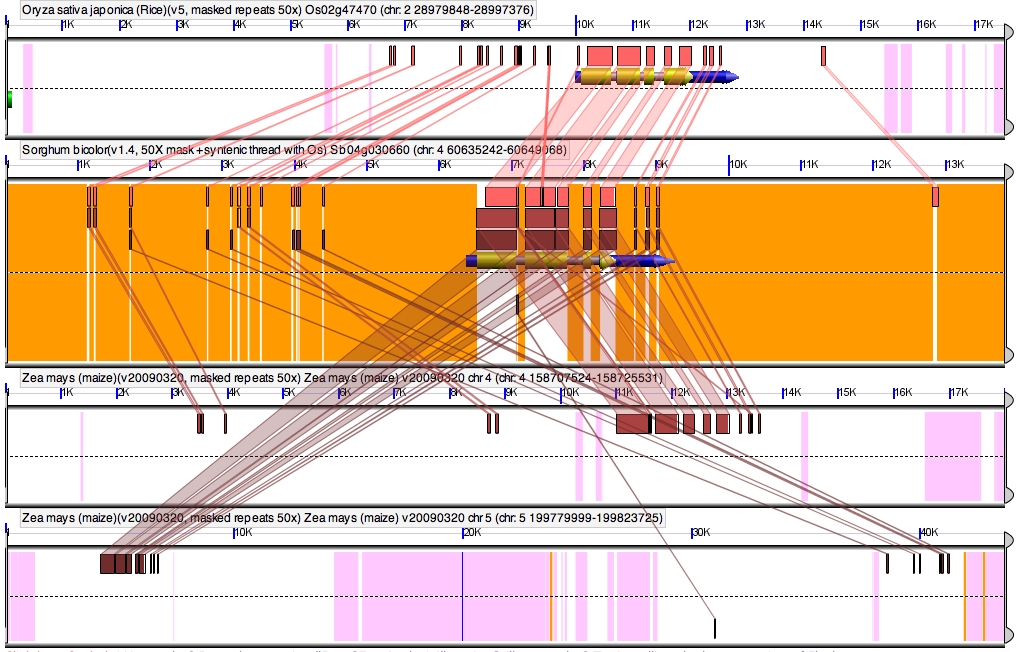
Blast hits between an orthologous quartet of gene spaces, one in rice, one in sorghum and the two copies created by the maize tetraploidy. As usual click the picture to see it fullsized
If you’d like you can even click here to be able to play around with the figure yourself using the CoGe interface. Now I’ve got to try to explain what this figure is about. (more…)
November 6, 2009
November 5, 2009
Bruce Sterling and Kim Stanley Robinson on Climate Change
This post was followed up by More on Why Science Isn’t a Perfect Fit with the Left or the Right
Bruce Sterling writes science fiction cyber-punk. Kim Stanley Robinson writes enormous science fiction trilogies. One on terraforming mars (Red Mars, Green Mars, and Blue Mars) that I read when I was younger and space mad. He’s also put out a more recent trilogy (40 Signs of Rain, 50 Degrees Below, and 60 Days and Counting) which I haven’t had a chance to read yet, but I’m told is quite good, and that at least the first book presents an accurate and depressing picture of the process for funding NSF grant proposals. Not something I want to think about I’m ~24 hours from submitting my own.
Kim Stanley Robinson recently did an interview for his new book Galileo’s Dream (you can find the whole text here). It’s a great read, although there’s plenty of stuff I disagree with.
One thing happening is that the Republican Party in the USA has decided to fight the idea of climate change (polls and studies show the shift over the first decade of this century, in terms of the leadership turning against it and the rank and file following), which is like the Catholic Church denying the Earth went around the sun in Galileo’s time; a big mistake they are going to crawl away from later and pretend never happened. And here the damage could be worse, because we need to act now.
What’s been set up and is playing out now is a huge world historical battle between science and capitalism. Science is insisting more emphatically every day that this is a real and present danger. Capitalism is saying it isn’t, because if it were true it would mean more government control of economies, more social justice (as a climate stabilization technique) and so on. These are the two big players in our civilization, so I say, be aware, watch the heavyweights go at it, and back science every chance you get. I speak to all fellow leftists around the world: science is now a leftism, and thank God; but capitalism is very, very strong. So it’s a dangerous moment. People who like their history dramatic and non-utopian should be pleased.
Reading the answer to this question made me feel a little weird about Mr. Robinson’s claiming of science for one side of the political debate (and also not a big fan science vs. capitalism, the climate change debate is more about the split between short and long term planning). Science isn’t a side in the political process, it’s a set of knowledge and tools that are openly available to all and political movements are free to either accept them, or, as sadly seems more common, toss them aside. Which is why Bruce Sterling’s response cracked me up: (more…)
November 3, 2009
Sugar Belle Citrus and Patents
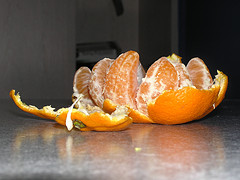
Mandarin Orange (Not a Sugar Belle) from dungodung on flickr
We’ve been talking about grains and genetic engineering strait for a few days, so I thought it’d be the perfect time to put up a story about conventionally bred citrus. The University of Florida put out a press release about a new mandarin orange breed developed by Fred Gmitter, called Sugar Belle. The fruit is of course described as delicious and it may well be, I can’t say one way or the other. Importantly to a different group of people (producers rather than consumers of citrus fruit), the fruit matures 4-6 weeks earlier than other varieties of mandarin, making the harvest better timed to cater to the demand for citrus around Christmas.
Fred has been developing the breed since 1985, when he found the tree Sugar Belle was bred from in the experimental plot of another plant breeder who’d just retired. That’s twenty-four years of research and development. 1985 is the year “new coke” was released. Soviet and Western forces still faced off against each other across the Berlin Wall. If Sugar Belle was a person, it’d already be old enough to be in grad school right now.
The lesson here (one of them) is that it takes a long time to breed fruit trees.
But that’s not the only interesting thing about this story. (more…)
October 31, 2009
Predictable Spinning of Squash
I don't have any picture of pumpkins handy, so this watermelon (and fellow cucurbit) will have to do.
What could be a more fitting topic for a Halloween post than cucurbits, the family of plants that (in addition to crops like watermelon and cucumber) include squash and pumpkins? Yeah, I know it’s a stretch.
A week ago a paper came out in PNAS (the proceedings of the national academy of sciences. A very prestigious journal, one step down from Science or Nature), that showed when an artificially inserted gene in squashes that provided virus resistance was introgressed into a wild related species it actually made them less fit. Short version: the wild squash also suffer from the virus which attacked domesticated squash but are also attacked by beetles, and the beetles prefer to eat squash without the virus. Tomorrow’s Table has a much better and more complete explanation of the research.
In that post the very first commenter predicted the result, that in this particular case a transgene (like most genes involved in domestication) was beneficial for farmers but not for wild plants, would be spun into “another failure for GMOs” when the real message is “we were worried about pollen drift, but in this case it turns out we didn’t have to be.”
He was right. (more…)
October 27, 2009
Banana Biology
When I was giving my lecture to on phylogeny and tetraploidies, I found out not everyone knows why bananas don’t have seeds.
The reason the bananas we eat don’t have seeds is that they are all sterile. A long time ago the Cavendish bananas first came into being when a tetraploid banana (that is a plant that has four copies of every chromosome instead of the normal two) mated with a normal diploid banana. The result, a banana with three copies of every chromosome couldn’t mate or produce seeds. One of the steps in making reproductive cells (the analog of human sperm and egg cells) is the even dividing of a plant’s chromosomes into two reproductive cells.* Normal diploid cells can easily divide into two cells (one copy of each chromosome in each cell), tetraploid plants can divide the same way (two copies of each chromosome in each cell). Hexaploid, three copies in each and so on. Odd numbers of chromosomes don’t work. The plants can’t successfully make the cells it needs to reproduce, if it can’t reproduce it can’t make seeds, and that is why bananas (or seedless watermelons) don’t have seeds. (more…)