James and the Giant Corn Rotating Header Image

Even today, cloning a gene is celebrated event

“Back in my day,” countless middle aged professors have said, “if you cloned a gene in grad school, that was it, you were done and graduated.”

Well times change, and cloning a gene isn’t quite as hard as it used to be. But don’t let the nostalgia a lot of old school geneticsts give off fool you into thinking identifying the gene responsible for some interesting mutant phenotype isn’t still a big deal.

Here are the three most recent papers I can think of off the top of my head reporting the cloning of maize mutants:

1. Myers A. M., James M. G., Lin Q., Yi G., Stinard P. S., Hennen-Bierwagen T. A., Becraft P. W., 2011 Maize opaque5 Encodes Monogalactosyldiacylglycerol Synthase and Specifically Affects Galactolipids Necessary for Amyloplast and Chloroplast Function. The Plant Cell Online.
2. Gallavotti A., Malcomber S., Gaines C., Stanfield S., Whipple C., Kellogg E., Schmidt R. J., 2011  BARREN STALK FASTIGIATE1 Is an AT-Hook Protein Required for the Formation of Maize Ears. The Plant Cell Online 23: 1756 -1771.
3. Sharma M., Cortes-Cruz M., Ahern K. R., McMullen M., Brutnell T. P., Chopra S., 2011  Identification of the Pr1 Gene Product Completes the Anthocyanin Biosynthesis Pathway of Maize. Genetics 188: 69 -79.
Two papers in The Plant Cell, which is probably the most prestigious plant specific journal out there, and one in genetics, where the cloning of a maize gene made the cover of a journal read by sciences who study everything from yeast to fruitflies to human beings.
Now what goes into a “we just cloned a gene!” paper has increased. You can’t just report the sequence of the gene, you need to do the hard work of beginning to figure out what the gene is actually doing on a molecular level to create a weird looking mutant corn plant. And you’ll probably need to pull together a couple of follow-up papers to turn your newly cloned gene into a PhD. But even today, with a (mostly) complete genome sequence to make identifying the mutations responsible for weird looking corn plants a whole lot easier, the contribution each newly cloned gene makes to our understanding of corn, of plants, and of biology as a whole, is too significant to be treated as anything less than a great accomplishment.
Share

A new version of the classical maize gene list is coming

People have been studying the genetics of maize pretty much since the word “genetics” entered the english language at the beginning of the 20th century and the community is full of people, myself included, who can trace their academic lineage back through generations of maize geneticsts to the founder of the field himself R. A. Emerson himself. Each generation laboring for decades (often in the blazing sun and sucking mud of cornfields that are about as far as possible from the air conditions labs and white lab coats that the word “geneticist” usual brings to mind) to increase our community’s understanding of this crazy plant and left a legacy of hundreds of genes whose functions do not need to be inferred by BLAST searches, conserved domains or expression patterns, but have been individually studied and quantified by talents scientists through years of field work and wet-lab experimentation.

The Classical Maize Gene list is an attempt to capture as much of that knowledge as possible and make it accessible and useful to the new generation of genomic researchers — who spend a lot more time in air conditioned comfort than our predecessors in the maize community (although I imagine I’d still get thoroughly laughed at if I showed up to work in a white labcoat).

With the announced release of a new version of the maize genome and maize gene models in august, it’s time for me to update the list again. But I need your help. If there are maize genes which have been cloned, but are missing from the current list (available here), please let me know using the “Contact Me” form at the top of this page and pass this appeal on to others you know who studies (or has studied in the past) maize.

Share

Adding to the list of surprising pineapple traits…

From an article on wired:

So-called nanocellulose fibers rival Kevlar in strength but are renewable, and the researchers believe they could be widely used within a couple of years. … Pineapple may be the most promising source of nanocellulose.

Clearly we have no choice, to secure future production of incredibly light/strong/renewable/biodegradable plastics, the time has come to sequence the pineapple genome.

Share

Is this thing still on?

::cough cough::

It’s kind of dusty in here… ;-)

Hi all, I know this site has been pretty dead for a long time. I hadn’t stopped writing, but a lot of that writing was re-directed into a series of scientific papers, now published. My plan is to post a series of postson these papers, but I’ve had a lot of plans to start writing again, and most of them have come to nothing, so until that happens: (more…)

Share

PAG is Almost Here!

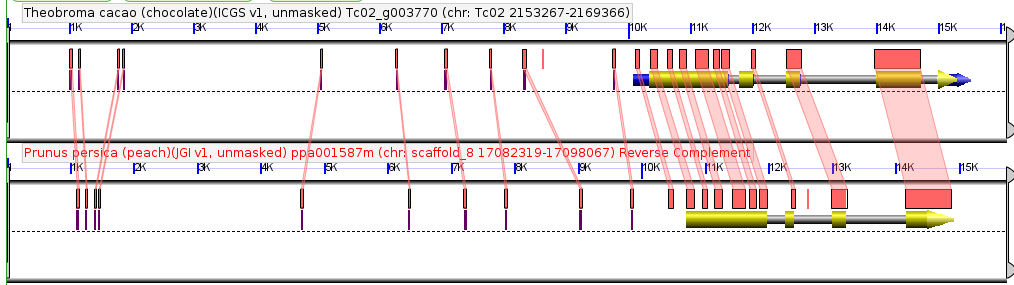
If you’re going to be at PAG too and find yourself bored during the poster presentation sessions on Monday, I’m be standing next to P230 “Fractionation Of A Tetraploidy Preceding The Diversification Of The Grasses.” (Please forgive the two “estimated”‘s in the first sentence of the abstract.)

Sometimes people on the internet have a hard time believing that yes, I do study plants, but no, it has absolutely no direct connection to genetic engineering one way or the other. Hopefully this abstract makes it abundantly clear that my research is exactly that. Fascinating but without direct commercial implications. The main bearing my research has on genetic engineering is that, using comparative genomics, I have the chance to see for myself the really crazy stuff that “natural” plants have been doing to their own genomes for millions of years.

After starring at enough dying corpses of genes and weird frankenstein amalgamations of exons from multiple old genes (annotation errors? real biological innovation?) it’s even harder to understand the mindset that a single introduced gene will likely to throw the entire system out of whack (and do so without condemning the plant to that great waste bin of all failed evolutionary innovation: inability to thrive and reproduce.)

Anyway, talk about tangents! The point is: if you’re not going to PAG, I hope you have a great weekend, if you are, hope to see you there.

Share

Research Funding is a Drop in the Bucket

I would urge anyone who reads this site to pop over to the Washington Post to read George Will’s column today on government funding for research. It starts off slowly but gets powerful fast. The arguments for why and how investments in basic research drive long term economics growth have all been made before, however one of the lessons I hope everyone takes away from his column is that even cutting research funding COMPLETELY won’t do anything to help with the long term problems in the federal budget:

Annual federal spending on mathematics, the physical sciences and engineering now equals only the increase in health-care costs every nine weeks. [Emphasis retained from the original]

The other statistic that’s going to stick in my head going forward is the percent of people graduating from college in the US who majored in the natural sciences or engineering. Less than one in six. In South Korea, more than 1 in 3 college students graduate with such a major. In China, the statistic is close to 1 in 2.

A lot of the stats he used came from a report called “Rising Above the Gathering Storm, Revisited” which you can download as a free PDF. The original report, which came out five years ago, focused mostly on the physical sciences because at the time funding for biosciences (as a whole) were doing comparatively well after a sustained increase in the budget of the National Institutes of Health*. The updated report makes it clear that since then:

However, shortly after the “doubling” in the health sciences was achieved, the funding for that activity was permitted to erode once again—the exception being a major one-time, two-year funding infusion as part of the American Recovery and Reinvestment Act.

Many of the findings of the Academies’ study regarding the physical sciences, mathematics and engineering now pertain to the biological sciences as well.

To really visualize what federal research funding looks like as a part of the federal budget, we turn to PhDComics inspire graph “Two Cents on the Dollar“:

*The National Institutes of Health fund research in some way related to human health or disease. National Science Foundation funded bioscience (where the money that plays for research in the REST of bioscience — including plant biology — comes from) is only 2% as much as the budget of NIH (going of the Jorge Cham’s numbers).

Share

Views on Science in High Places

“[Mr. X] told the assembled groups that science itself is subjective, and that he could have three different groups bring him three different supposedly scientific opinions.”

Any guesses on the identity of Mr. X? Could he be a creationist arguing for the inclusion of intelligent design alongside science in the classroom? A new-age radical arguing that alternative medicines are just as scientifically effective was … well medicine? Maybe the most likely bet would be a sceptic of global warming, they’ve been in the press a lot lately, what with temperatures falling across the northern hemisphere (it’s apparently winter you see).

Unfortunately the person in question is (according to an article posted in the wall street journal), US Secretary of Agriculture Tom Vilsack. (more…)

Share

I Am So Excited About P.A.G.

From a behind the scenes explanation of how the strawberry genome (and the strawberry genome paper which is quite a different kind of project) came to be:

Dr. Tom Davis from University of New Hampshire submitted the letter of intent for the January 13, 2006 deadline, days before the Plant Animal Genome meeting in San Diego. At the Rosaceae Executive Committee annual meeting on Jan. 15 Tom announced that he had submitted the letter.  … Tom was convinced to withdraw his strawberry sequencing proposal, differing to the eventual DOE-JGI support of peach.

At PAG in San Diego, 2008, Vladimir Shulaev and Richard Veilleux from Virginia Tech attended the Rosaceae Executive Committee meeting.   Vladimir announced that Virginia Tech had thrown support behind the idea of genome sequencing- both some financial support as well as technical and facility support.  This was the seed that was needed.  The discussion had a pure “pass-the-hat” flavor to it.  Nobody had big funds, but Vlad and Richard had a big idea.  That proved to eliminate the first major barrier to a complete sequence.

Luckily some enthusiasm was found at PAG 2010.  Vladimir presented the genome work at a major symposium.  It looked awfully sweet on the big screen and many of us felt a sense of prime time.  It was energizing. Todd Mockler, Todd Michael and Tom Davis met.  Later that night we had a strategy-n-pizza meeting with all of those present in the consortium.

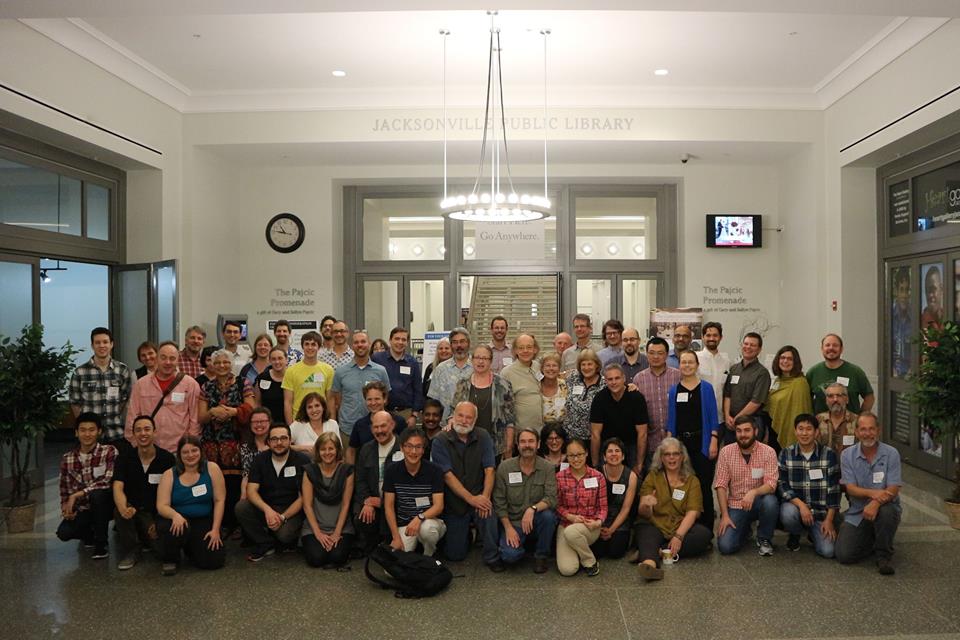
The whole thing is a fascinating read, especially if you’ve never had a chance to hear about the politics and organization that go into sequencing a plant genome. But the point I’m making with the quotes I’ve pulled from the article is that P.A.G. seems to be the meeting for people from across the community to come together to plan and work on these large collaborations.

This year I’m most going to be there to take in the sights and find out what approaches other people are using since there aren’t a lot of other labs at my home institution that carry out related kinds of research, but it’s exciting to think that someday I might get to be involved in the back door wheeling and dealing that makes large collaborative science work!

Also, reading how the strawberry genome took from 10 months from its first rejection in February to its final publication yesterday helps put my own self pity about (not nearly as data rich) a manuscript I’ve been trying to get published since June into perspective. ;-)

Share

Woodland Strawberry Genome Published (For Real This Time)

Hi all, hope you’re enjoying the holiday break. I’m back with news of a new plant genome publication!

Today’s plant is the woodland strawberry (Fragaria vesca). Now these aren’t the strawberries you probably see at your local grocery store, those are garden strawberries (Fragaria x ananassa). Woodland strawberries were the predominant strawberries grown throughout europe until around 250 years ago when they were displaced by the new garden strawberries — created when a strawberry species brought from north america crossed with another species from chile when they were grown next to each other in france. The new hybrid species bore larger fruit than the woodland strawberry.

Wild strawberry (left) and domesticated strawberry (right). I'm not sure which species these are, downside of having to hunt down public domain photos.

Sequencing the genome of the garden strawberry directly would be a real mess, as the genome of that species is made up of four closely related genome-copies*. With modern DNA-sequencing technology, generating the raw sequence data that makes up a genome is — relatively — cheap and easy, but afterwards you are left with a lot of small pieces of DNA sequence, and putting those pieces together (like putting together a puzzle with millions of pieces) remains challenging. Mix together pieces from four closely related puzzles together with no way to tell them apart and the project becomes even more challenging.

Fortunately the woodland strawberry side-steps that problem, being a normal diploid plant without any of the whole genome duplications that would make sequencing garden strawberries such a terrible mess. It also has a pleasingly small genome, with a genome of 206 million base pairs spread over seven chromosomes, making it only slightly larger than the genome of the first plant to be sequenced (Arabidopsis 157 million base pairs and five chromosomes). Small genomes are easier to put together, with less total pieces to go around.

The research consortium that sequenced and assembled the strawberry genome, first assembled overlapping pieces of sequenced DNA into larger pieces called contigs and then using genetic map data to line those contigs up into seven pseudomolecules, each of which represents a whole strawberry chromosome. The strawberry genome itself wasn’t released prior to the publication of the paper, so I haven’t had a chance to look at it myself, but both the fact that they’ve been able to assemble all the way to the chromosome level, and that they developed and used genetic map data argue for a well done assembly.

Speaking of assembly, here are all the vital genome stats that I normally would have to hunt around for after reading a “new genome sequenced!” story in the popular press (some of these I’ve already mentioned above):

  • Strawberries have a haploid number of 7, and a genome size of 206 MB
  • The average base pair in the strawberry genome was sequenced 39 times using second generation technology (a label that includes Illumina, 454, and SOLiD sequencers, in this case a mixture of all three technologies were employed)
  • 34,809 predicted genes were identified across the strawberry genome.
  • The authors found no evidence of the whole genome duplications found in other rosids (I’m assuming this means the most recent whole genome duplication in the ancestors of strawberries was the pre-rosid hexaploidy.)
  • The paper describing the genome will shortly be available from Nature Genetics. The title is “The genome of the woodland strawberry (Fragaria vesca)” and the last name of the first author is Shulaev. UPDATE: Here’s the link to the genome paper.

Strawberry genome browser.

Aside from the enjoyment I always feel when a new genome goes live, I’m particularly happy to see the strawberry genome come out for two reasons.

The first is that there was no “strawberry genome” grant. Funding for sequencing the genome came from a number of sources. I take this as a sign that in addition to the rapidly declining cost of sequencing itself, the cost and difficulty of assembling and annotating the genome a new plant species are also continuing to decline at a rapid pace.

The second reason is that I once before announced the sequencing of the strawberry genome on this site. It was almost a year ago, after a reporter misunderstood a presentation at PAG and posted a “new genome sequenced” story online that was rapidly picked up by  a number of websites including my own. It was a bad break for the folks working hard to sequence, assemble, and annotate the real strawberry genome, and I’m very glad to see them get the moment in the spotlight they so richly deserve. The people who sequence genomes make the work of so many other researchers, including myself, possible.

Links to other coverage (updated as I find them):

*Either the result of duplicated copies of a single genome that have since evolved independently (autotetraploidy), or hybrids that merged the genomes of closely related strawberry species together in a single plant (allotetraploidy).

Share

How weird are grasses?

Weird enough that suggestions like this make it into the scientific literature:

Given the large number of new genes with different GC structures in grasses, perhaps the lineage was initiated by a wide hybridization event with another species that had genes with a high GC content, followed by selective gene retention and loss to create today’s Poaceae. The wide hybridization, while most likely to have involved a plant species, could have been prokaryotic or algal and, a prokaryotic origin could explain the higher proportion of intronless Poaceae-specific genes (1).

The above text comes from a paper published just two years ago (one year before the publication of the maize genome) describing the sequence of thousands of maize genes. It’s a wild claim — hybridizing with a prokaryote (bacteria) or algae not the wide cross part — and one I personally don’t think is very likely. But the reason people can make it with a straight face is because grasses are so different from everything that came before them, and so successful.

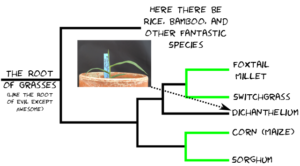
Grasses look and act almost nothing like the species they’re related to — the grass family belongs to the same order (the next organizational step up) as pineapples. They’re flowering plants but have either discarded things as basic to flowers as petals or modified them into something completely unrecognizable (the petals and sepals of other flowering plants might have become the lemmas, paleas, and/or lodicules of grasses).  Grasses have also reversed course from most flowering plants that depend on birds or insects to carry pollen from one plant to another and gone back to good old wind pollination. Yet, without the necessity of appealing to different pollinators to drive speciation, the grass family still encompasses more than ten-thousand species. And in the 50 or so million years or so since the major grass families split from each other, they have reshaped a whole quarter of the earth’s surface (2) creating whole new ecosystems (grasslands) that never existed before.

  1. Nickolai N Alexandrov et al., “Insights into corn genes derived from large-scale cDNA sequencing,” Plant Molecular Biology 69, no. 1 (January 2009): 179-194.
  2. H. L. Shantz, “The Place of Grasslands in the Earth’s Cover,” Ecology 35, no. 2 (April 1954): 143-145.
Share